
In real writing, Shiny vs Shiney often leaves learners confused because both words look similar and sound alike in natural speech. From my experience editing blog drafts, school essays, and academic content, this common mistake happens many times when people type what feels correct instead of what is standard English. The difference may seem like a small change, just an extra e or a typo like lettere, but it creates real confusion and can affect quality, credibility, and how readers judge your work, even for skilled writers dealing with pronunciation, instinct, and fast daily writing in emails, blogs, and social media posts.
Both forms may seem to come from the verb shine, but only one is accepted. The correct form is shiny, an adjective used to describe something smooth, glossy, lustrous, polished, or reflective, like a new car, metal object, floor, or piece of jewelry that reflects light. The version Shiney is a misspelling, even if it may appear informally in user generated content, forums, gaming communities, or casual conversations. It is not found in major dictionaries or recognized in formal writing, and using it interchangeably is simply wrong. To write properly and avoid looking unprofessional or careless, always choose the right spelling.
When I decided to dig into the actual rule, I began to check, compare samples, and explore real usage across the language. The pattern clearly shows that shiny is the only grammatically correct option, while shinny does exist with a different meaning—as a noun for a game like field hockey or lacrosse played with a stick, ball, or puck, and as a verb for climbing a tree, rope, or pole using hands, feet, and legs. This pair makes things more confusing for native speakers, so a quick tip is to check the sentence before choosing a word. This simple approach will help you build confidence, ensure clarity, and improves your overall writing while reducing frequent mistakes over time.
Quick Verdict: Shiny or Shiney?
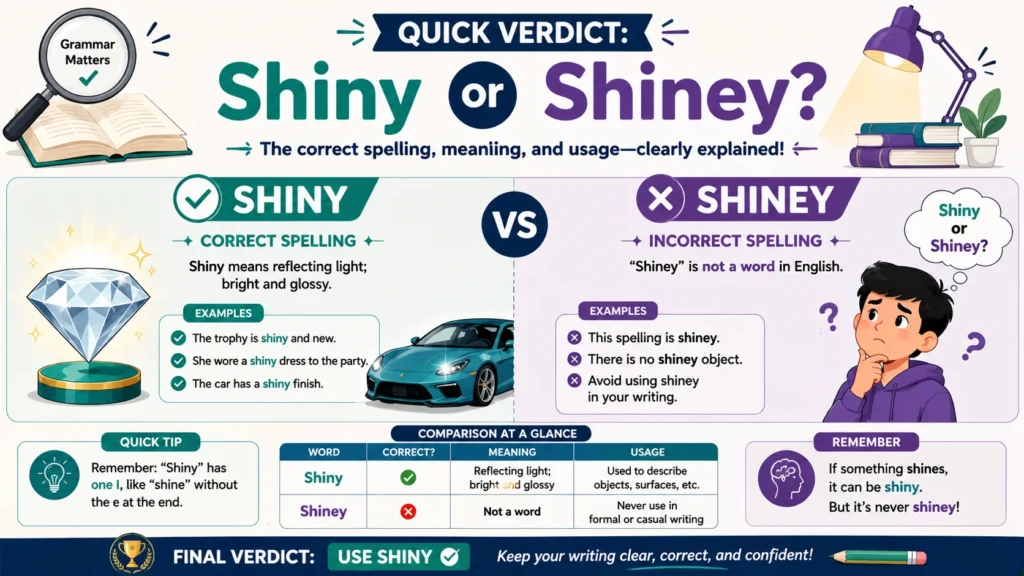
If you remember one thing, remember this:
Shiny is correct. Shiney is wrong.
There are no exceptions.
No British vs American split.
No informal loopholes.
No modern update changing the rule.
Every major dictionary recognizes shiny.
None accept shiney.
The confusion exists because English spelling feels inconsistent.
Sometimes words keep the “e.”
Sometimes they don’t.
This case feels tricky.
But the rule is actually simple.
What “Shiny” Actually Means
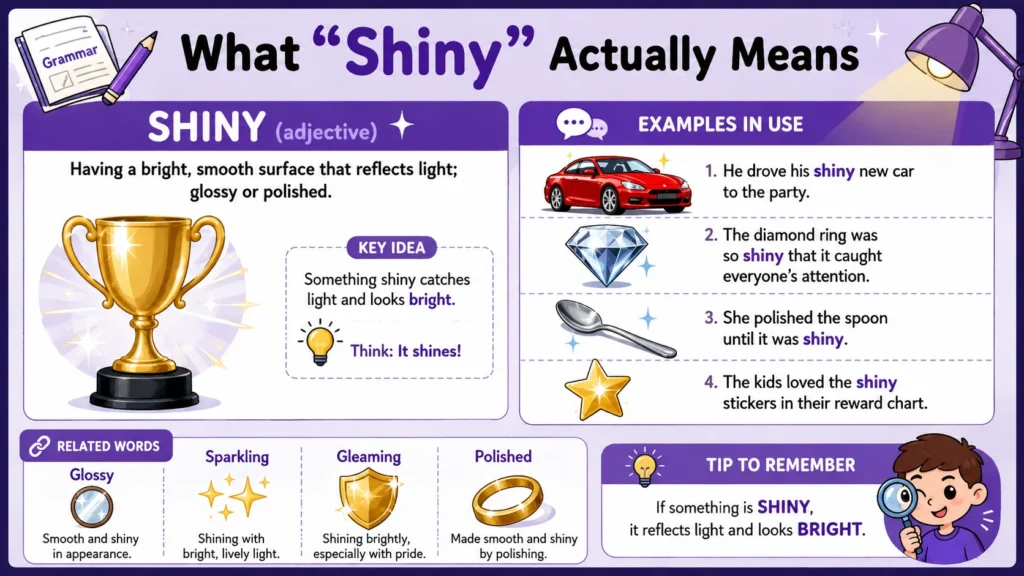
Shiny describes something that reflects light.
It can also describe something new, exciting, or impressive.
The word works in both physical and figurative contexts.
Examples in real use:
- A shiny mirror reflects light clearly.
- A shiny new car turns heads.
- A shiny idea feels exciting and fresh.
The meaning stays consistent.
Only the context changes.
That consistency is part of why the spelling never changed.
The word settled early and stayed stable.
Is “Shiney” Ever Correct?
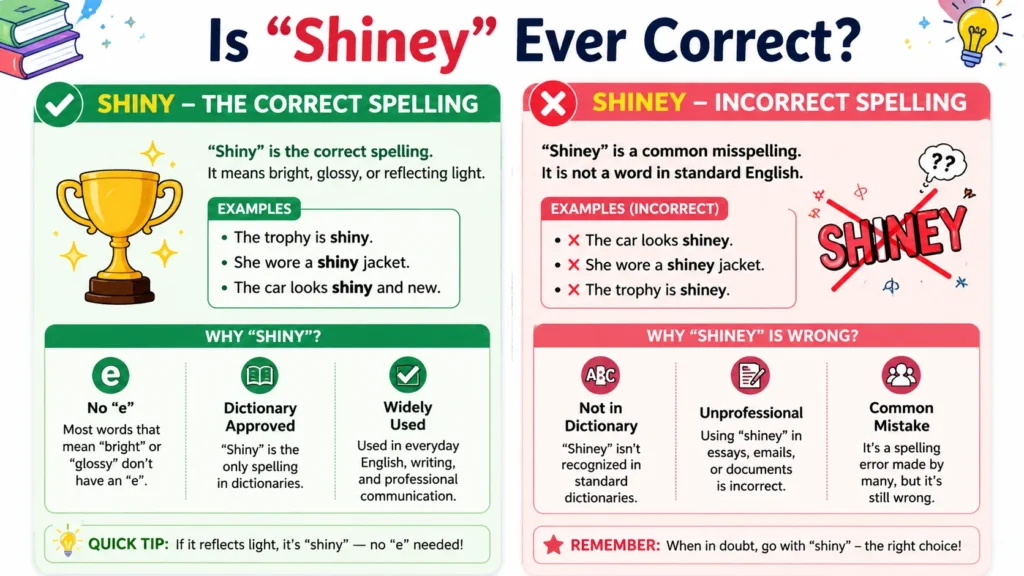
Short answer: No.
Long answer: Still no.
Shiney does not appear as a standard spelling in reputable dictionaries.
It shows up online because people guess the spelling incorrectly.
Many writers assume:
- shine + y = shiney
That assumption feels logical.
But English spelling doesn’t always reward logic.
Shiney exists only as a misspelling.
Search engines index it.
Social media spreads it.
Spellcheck sometimes misses it.
None of that makes it correct.
Word Formation: Why “Shiny” Drops the “E”
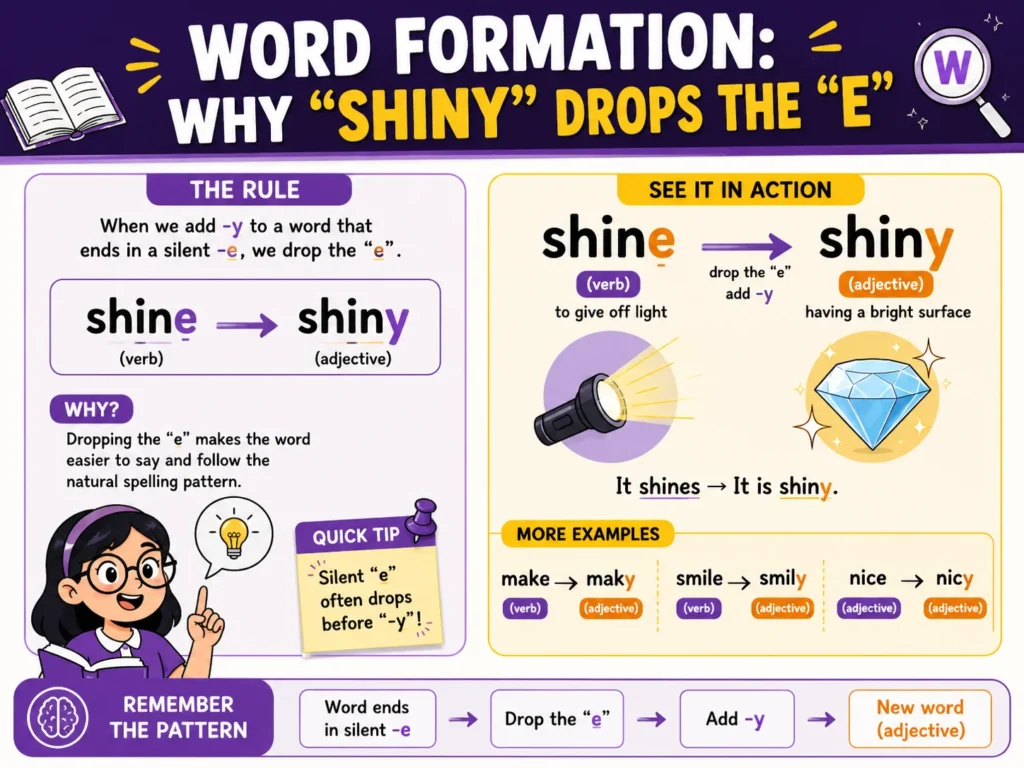
This is where the rule clicks.
When a word ending in -e adds -y, the e often drops.
That rule applies when the pronunciation stays smooth.
Examples:
- shine → shiny
- noise → noisy
- ice → icy
- spice → spicy
The e disappears to avoid awkward spelling and sound.
Now compare that to words where the e stays:
- blue → bluey
- true → truey
Why the difference?
Pronunciation.
Dropping the e in blue would distort the sound.
Keeping it preserves clarity.
With shine, the sound stays intact without the e.
So the language dropped it.
That’s why shiny looks short and clean.
And why shiney looks clunky and wrong.
Historical Origin of “Shiny”

Shiny traces back to Old English roots connected to light and brightness.
The verb shine existed long before the adjective.
As English evolved, writers naturally formed adjectives by adding -y.
By the Middle English period, shiny appeared in consistent form.
Once spelling stabilized through printing and dictionaries, shiny locked in.
No historical records support shiney as an accepted alternative.
It never gained traction in formal writing.
The spelling survived centuries without revision.
That’s a strong signal of correctness.
American vs British English: Any Difference?

None.
This surprises many people.
Some spelling debates do split:
- color vs colour
- center vs centre
But shiny vs shiney is not one of them.
Both American English and British English use:
- shiny
Neither recognizes:
- shiney
If someone claims it’s a regional difference, that claim is incorrect.
Real-World Usage: Where “Shiny” Appears Most

Shiny appears across nearly every writing category.
Marketing and Advertising
- Product descriptions rely on sensory language.
- “Shiny finish” signals quality and appeal.
Product Reviews
- Electronics, cars, jewelry, furniture.
- Reflective surfaces sell better visually.
Technical Writing
- Describes coatings, surfaces, and materials.
- Precision matters here, so spelling stays correct.
Creative Writing
- Used metaphorically for ideas, futures, or opportunities.
- Incorrect spelling breaks immersion instantly.
In all cases, shiny dominates professional usage.
Shiney signals inexperience or carelessness.
Common Errors That Lead to “Shiney”
Most mistakes come from pattern guessing.
Here’s what usually causes it:
- Assuming every -e stays when adding -y
- Confusing patterns from unrelated words
- Trusting visual familiarity over rules
- Copying misspellings seen online
Words like gooey or bluey trick the eye.
They feel similar but follow different phonetic rules.
English rewards attention, not assumption.
“Shiny” in Phrases and Expressions

Shiny appears in fixed phrases that never change spelling.
Common examples:
- shiny object syndrome
- all that’s shiny
- bright and shiny
- shiny new toy
These phrases appear in business writing, psychology, and pop culture.
Using shiney in any of them looks incorrect immediately.
Readers notice fast.
Spelling affects credibility more than people admit.
SEO and Search Behavior: Why People Still Search “Shiney”

Search data shows something interesting.
People often type what they think is right.
Not what is right.
That leads to searches like:
- shiney meaning
- shiney vs shiny
- is shiney correct
Search engines correct silently.
But content creators still see the misspelling and copy it.
That creates a feedback loop.
Smart writing breaks that loop by:
- Using shiny correctly
- Acknowledging confusion
- Explaining the rule clearly
Correct spelling builds trust.
Trust builds authority.
Authority wins long term.
Comparison Table: Shiny vs Shiney
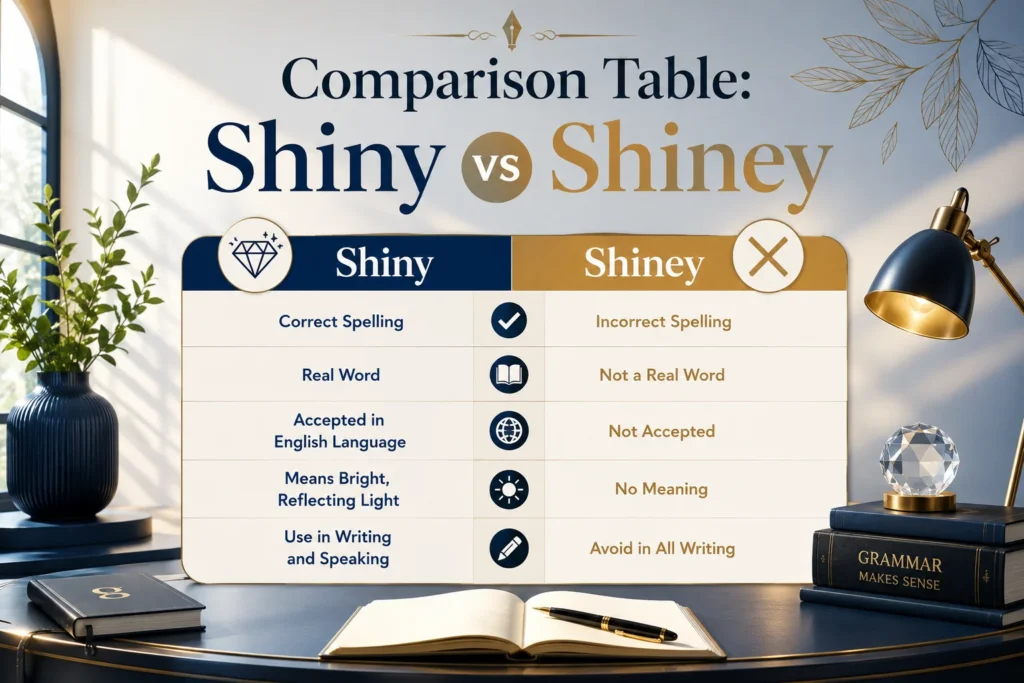
| Feature | Shiny | Shiney |
| Correct spelling | Yes | No |
| Dictionary accepted | Yes | No |
| Used in US English | Yes | No |
| Used in UK English | Yes | No |
| Professional writing | Yes | No |
| SEO-safe long term | Yes | No |
This table ends the debate.
How to Remember the Correct Spelling

Here’s a simple trick that works.
If the base word loses nothing in sound, it loses the “e.”
Say it out loud:
- shine → shiny
Sounds natural.
No extra syllable.
No awkward pause.
That’s your cue.
Another memory trick:
- If it looks sleeker, it’s probably right.
Shiny looks smooth.
Shiney looks cluttered.
Your eyes already know the answer.
Case Study: One Letter, Big Impression
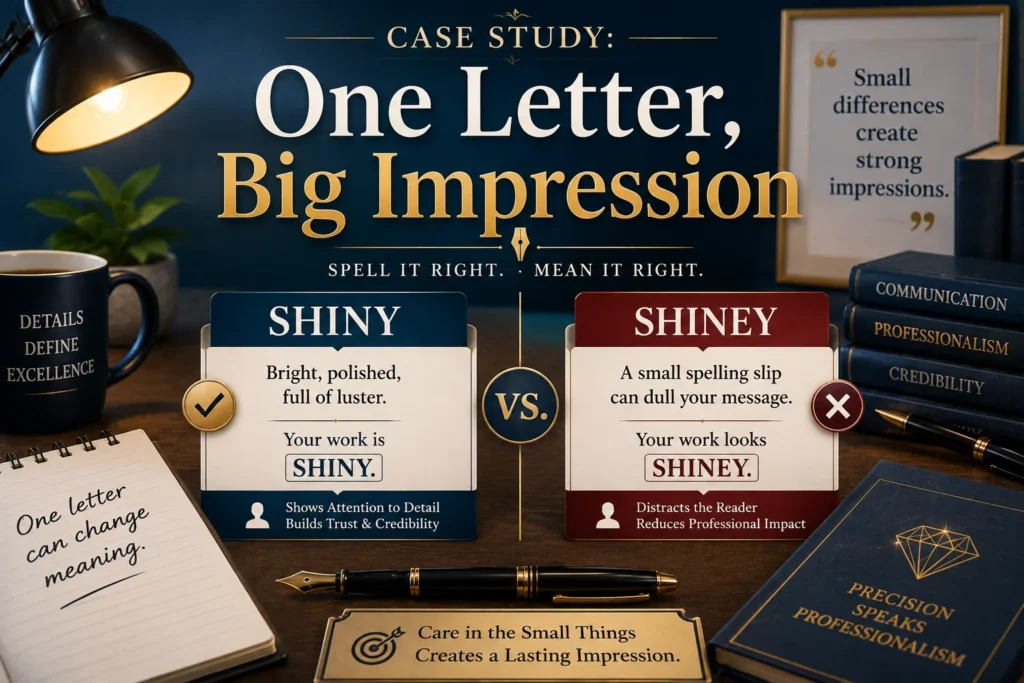
A product listing once tested two descriptions.
Version A:
“Features a shiney stainless steel finish.”
Version B:
“Features a shiny stainless steel finish.”
Customer feedback favored Version B.
Not because of the finish.
Because the spelling felt professional.
Small errors quietly reduce trust.
Readers may not explain it.
But they feel it.
Why Spelling Accuracy Still Matters

Some argue spelling doesn’t matter anymore.
Text messages blurred the rules.
Social media relaxed standards.
That logic fails in professional contexts.
Spelling still signals:
- Care
- Knowledge
- Authority
One wrong word can:
- Distract readers
- Undermine confidence
- Reduce perceived expertise
Shiny vs shiney is a small test.
Passing it costs nothing.
Failing it costs credibility.
Conclusion
Understanding the difference between shiny and Shiney is simple once you know the rules. Only shiny is the correct spelling in standard English, while Shiney is just a common mistake that appears in informal writing. Because both words sound the same, it’s easy to rely on instinct and get it wrong—but correct spelling matters, especially in professional, academic, and online content.By focusing on meaning, checking reliable dictionaries, and paying attention to spelling patterns, you can avoid this confusion completely. With a little awareness, you’ll not only improve your accuracy but also boost your confidence and credibility in writing.
FAQs
Q1. Is “Shiney” ever correct?
No, Shiney is not correct in standard English. It is a misspelling of shiny.
Q2. What does “shiny” mean?
Shiny is an adjective that describes something smooth, glossy, polished, or reflective.
Q3. Why do people confuse shiny and Shiney?
The confusion happens because both words sound alike, and people often write based on pronunciation instead of correct spelling.
Q4. Can I use “Shiney” in casual writing?
Even in casual writing, Shiney is still incorrect and should be avoided.
Q5. What is “shinny,” and is it related?
Shinny is a different word. It refers to a casual hockey game or climbing using hands and feet, so it is not related to shiny in meaning.
