
Happened vs Happend often creates confusion when people type quickly and question if their spelling is correct or not in daily writing.In my experience, people often type happend while writing a message, email, or social media post, then pause and ask themselves if it is correct or should be happened. This confusion is very common, especially among English learners who want to write clear and correct sentences. Many search questions appear around how to spell the word or understand its meaning, because spelling rules can sometimes change letters when verbs move into the past tense. That is where understanding becomes important for clear communication and good writing.
From what I have seen, even one wrong sentence can look confusing and unprofessional, which is why using a helpful guide to learn pronunciation, rules, and examples is key. When you discover how to use happens and happened, you avoid mistakes with a word used in everyday life. By the end of any article, you should clearly understand the right form and why it matters to write properly in English.
I have personally noticed that people who encounter pitfalls often muddle ideas, even when the source of the issue is simple. The key is knowing how to write correctly, since the correct form is actually happened, with an extra e before the ed ending. Remembering this difference will help you avoid errors in both casual and formal contexts. If you explore usage, check definitions, and practice with real words, you will quickly know why happend is a misspelling and how to fix it when dealing with similar cases.
What “Happened” Means (Target Keyword: Happened vs Happend)
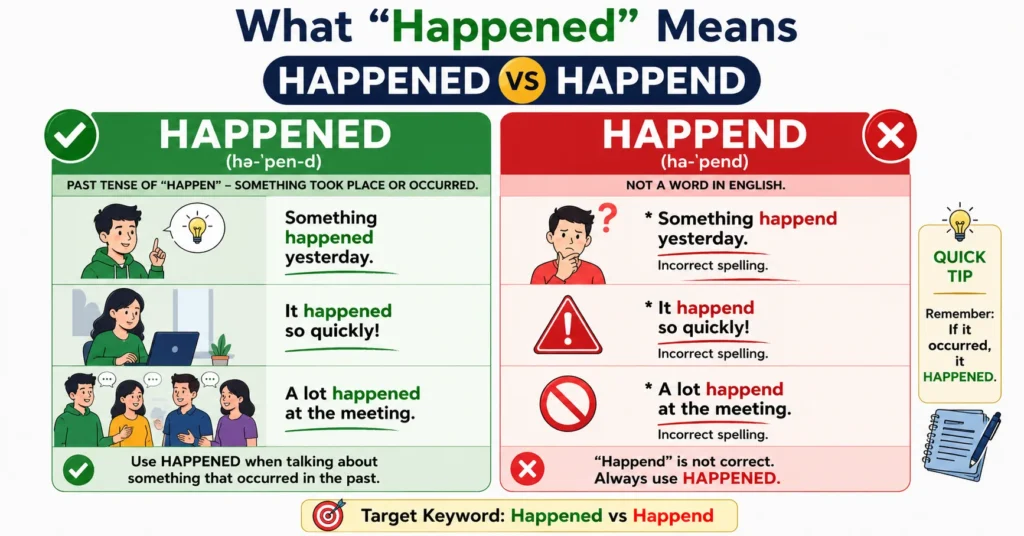
The word happened carries a clear and straightforward definition. It’s the past tense and past participle of the verb “happen which means “to occur” or “to take place.” Anytime you’re describing an event that already occurred, happened is the correct spelling.
You’ll use happened when:
- describing something completed in the past
- telling stories
- reporting incidents
- writing emails with updates
- explaining events in chronological order
Even though it’s simple at first glance, its grammatical behavior plays a huge role in why people often confuse happened vs happend.
How “Happened” Works in Real Sentences
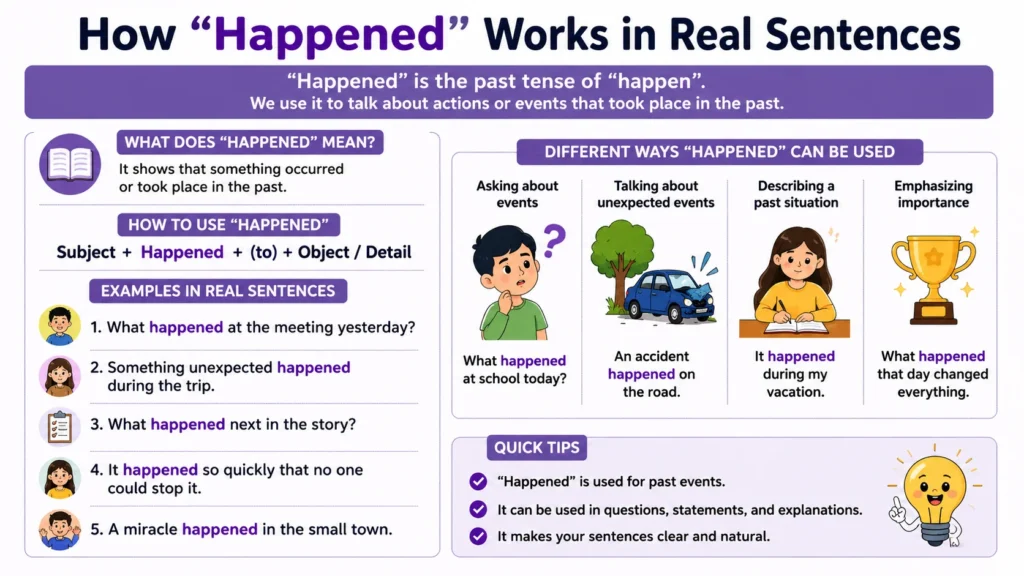
Understanding how the word behaves in different sentence structures helps you see why it always keeps the -ed ending.
Everyday Use
You’ll find “happened” everywhere because people use it constantly in casual speech.
Examples:
- “Something crazy happened today.”
- “I forgot what happened after that.”
- “Guess what happened at work.”
Professional Use
Workplace communication requires clarity and accuracy.
Examples:
- “A system delay happened during the software update.”
- “This issue happened because of a scheduling conflict.”
Storytelling
Narratives rely heavily on past tense verbs.
Examples:
- “Nothing happened the way we planned.”
- “Everything happened so fast that I barely reacted.”
With Helping Verbs
When you combine “happened” with auxiliary verbs, it strengthens the meaning.
Examples:
- “It has happened before.”
- “If that had happened earlier we’d be prepared.”
In every case, the ending -ed stays intact. That small detail becomes crucial when comparing happened vs happend.
Why “Happend” Is Incorrect
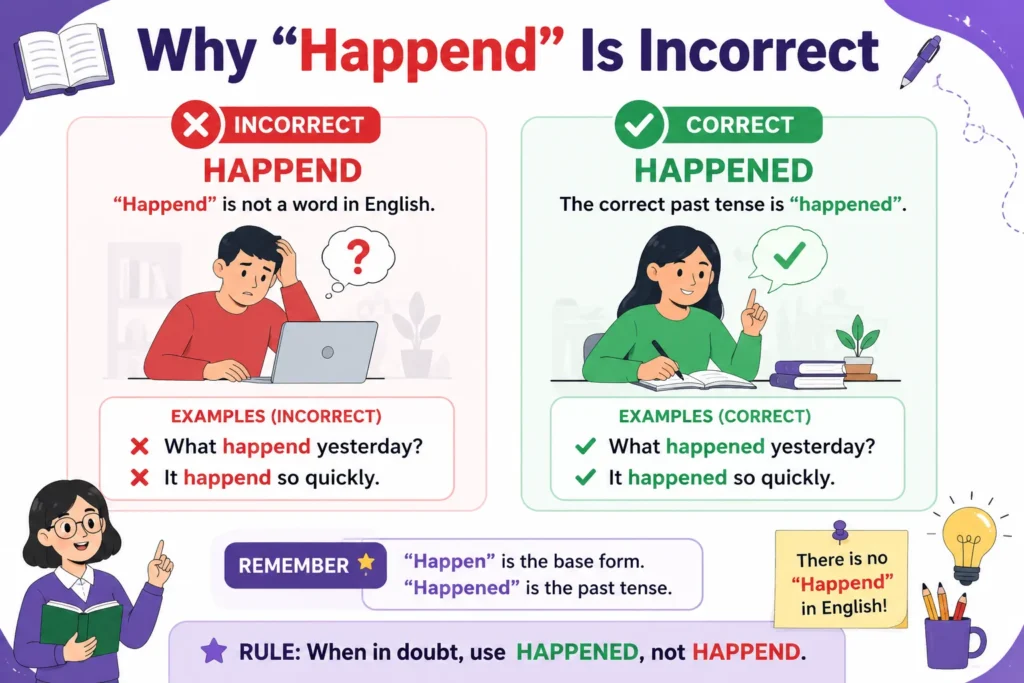
The spelling happend doesn’t exist in standard English. It doesn’t belong to any dialect, region, informal variation, or slang. No dictionary recognizes it because the word violates essential English spelling rules.
Here’s why this mistake happens so often:
- People assume the consonant should double (like “stopped” or “chopped”).
- The second “e” in “happened” feels silent which makes the correct spelling look odd.
- English spelling patterns can trick your eye into thinking something is wrong when it isn’t.
Still the fact remains: happend is never correct in any context. If you’re comparing Happened vs Happend, the correct choice is always happened.
The Grammar Rule That Explains the Correct Spelling
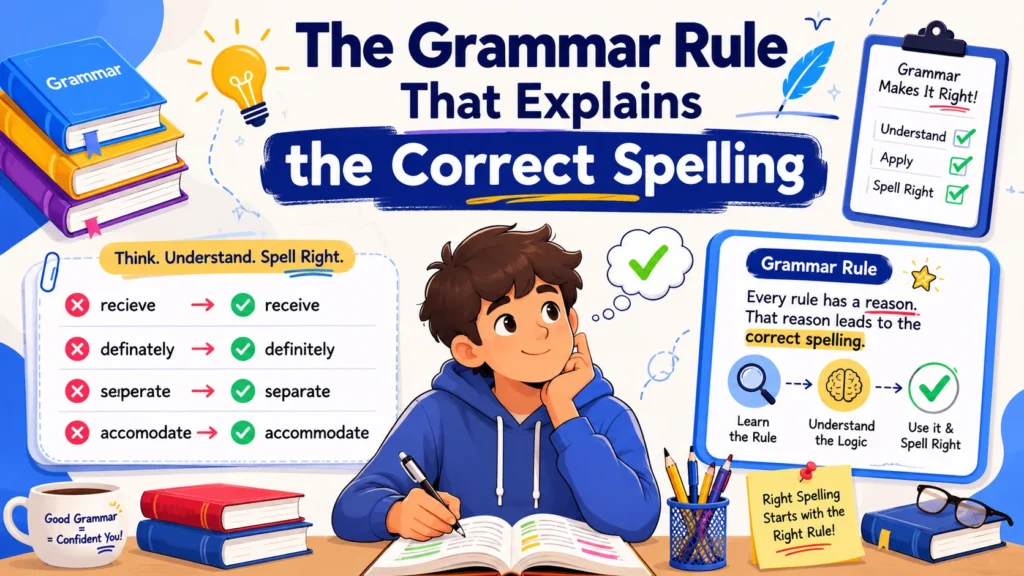
You can understand the spelling of “happened” by looking at one simple rule.
When a verb ends in a consonant + vowel + consonant, the final consonant only doubles when the final syllable is stressed.
Let’s break this down.
The verb happen has two syllables:
- HAP-pen (stress on the first syllable)
Since the stress lives on the first syllable, the “p” doesn’t double. That’s why the correct past tense becomes:
➡️ happen → happened
❌ not happend
To make things clearer, here’s a comparison table.
Table: Verbs With the Same Spelling Pattern
| Base Verb | Correct Past Tense | Incorrect Form | Why |
| Happen | Happened | Happend | First-syllable stress |
| Open | Opened | Openned | No stressed final syllable |
| Listen | Listened | Listenned | Consonant stays single |
| Offer | Offered | Offerred | Same rule applies |
When you compare happened vs happend, the rule becomes impossible to ignore.
Common Ways to Use “Happened” in Sentences
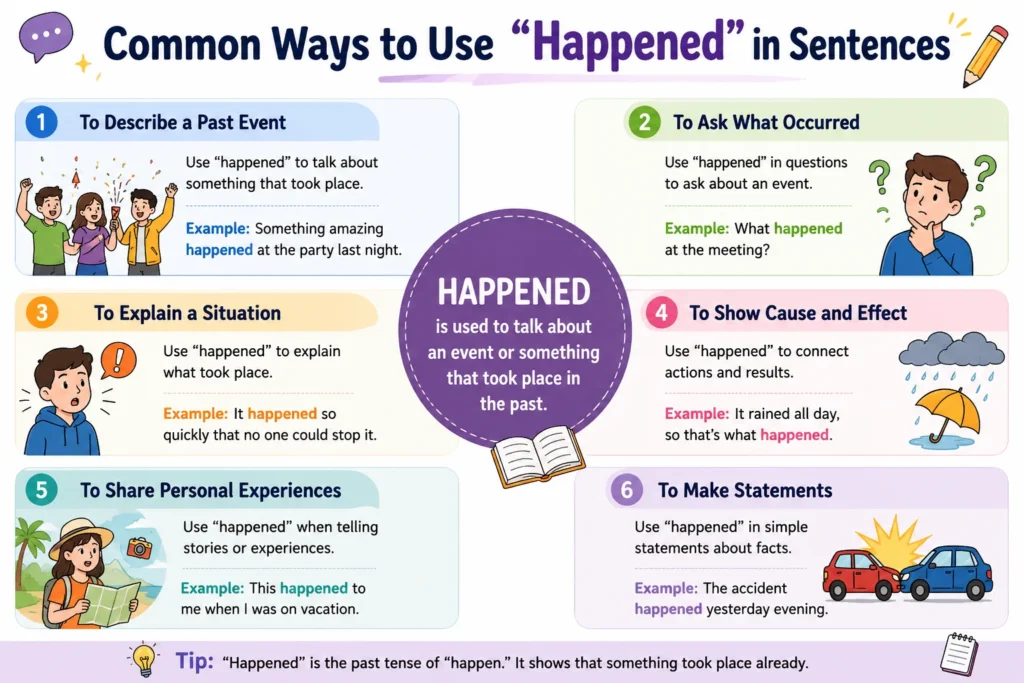
You’ll encounter “happened” across various scenarios. These real examples show how native speakers naturally use the word across different registers.
Casual Use
- “I don’t know what happened earlier.”
- “It happened while I was asleep.”
Workplace Communication
- “A delay happened because of a missing attachment.”
- “This error happened during the last update.”
Academic Writing
- “Several changes happened after the experiment began.”
Customer Service
- “We’re sorry this happened and we’re working on a solution.”
Storytelling
- “Everything happened in seconds.”
Each example strengthens your instinct for when and how to use it.
Common Synonyms for “Happened” and How They Differ
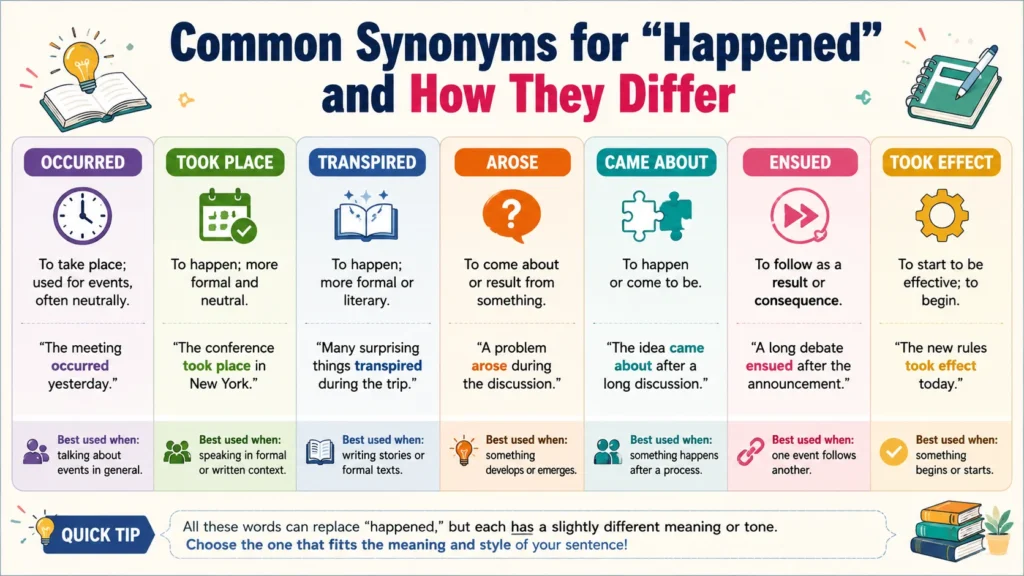
Sometimes “happened” feels too plain for what you want to express. These synonyms help you choose the best word for each context.
Synonym Table With Use Cases
| Synonym | Best Use Case | Example |
| Occurred | Formal writing | “A delay occurred during testing.” |
| Took place | Scheduled events | “The conference took place last Monday.” |
| Transpired | More dramatic tone | “It later transpired that the data was incorrect.” |
| Came about | Processes or gradual events | “The issue came about after the update.” |
| Ensued | Chain reactions | “A disagreement ensued.” |
Choosing the right synonym can help your writing sound more precise and polished.
Happened vs Happend: Side-by-Side Comparison
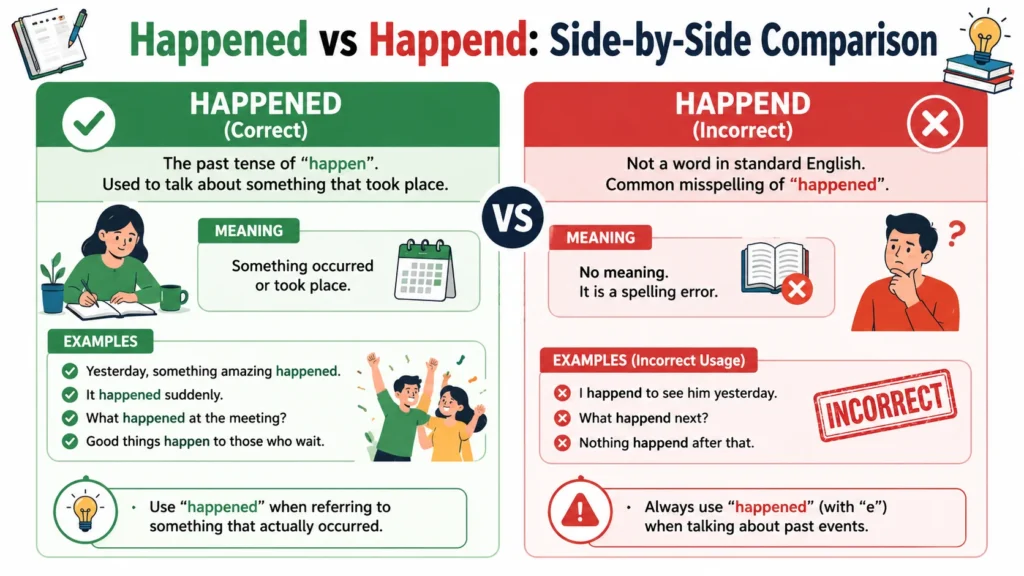
This simple chart highlights the main difference.
Comparison Table
| Feature | Happened | Happend |
| Correct Spelling | ✔ Yes | ✘ No |
| Recognized by Dictionaries | Yes | No |
| Acceptable in Any English Dialect | Yes | No |
| Grammatical Role | Past tense / past participle | Not applicable |
Whenever you weigh Happened vs Happend, you’ll always land on the side of “happened.”
Why Writing “Happened” Correctly Matters
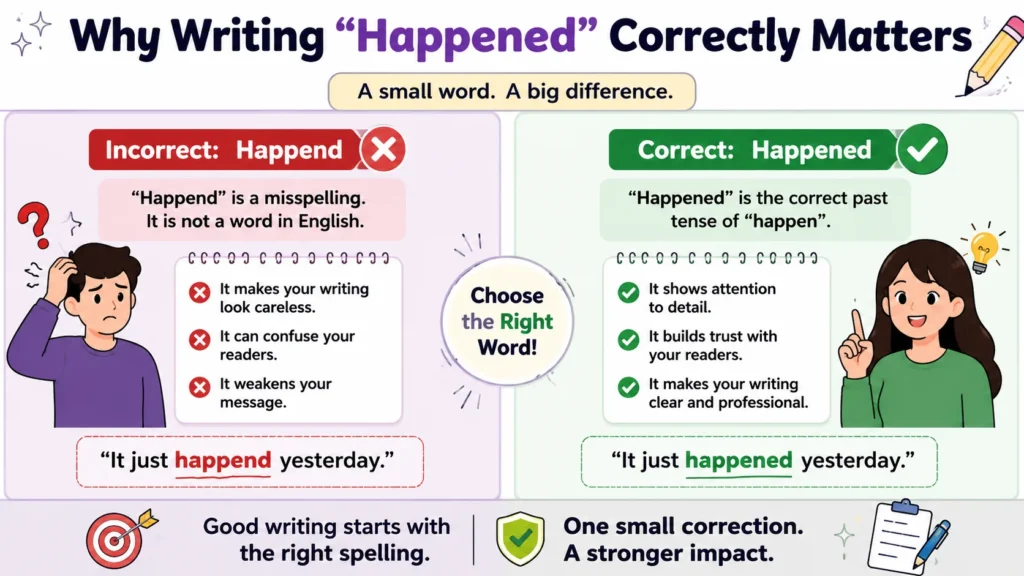
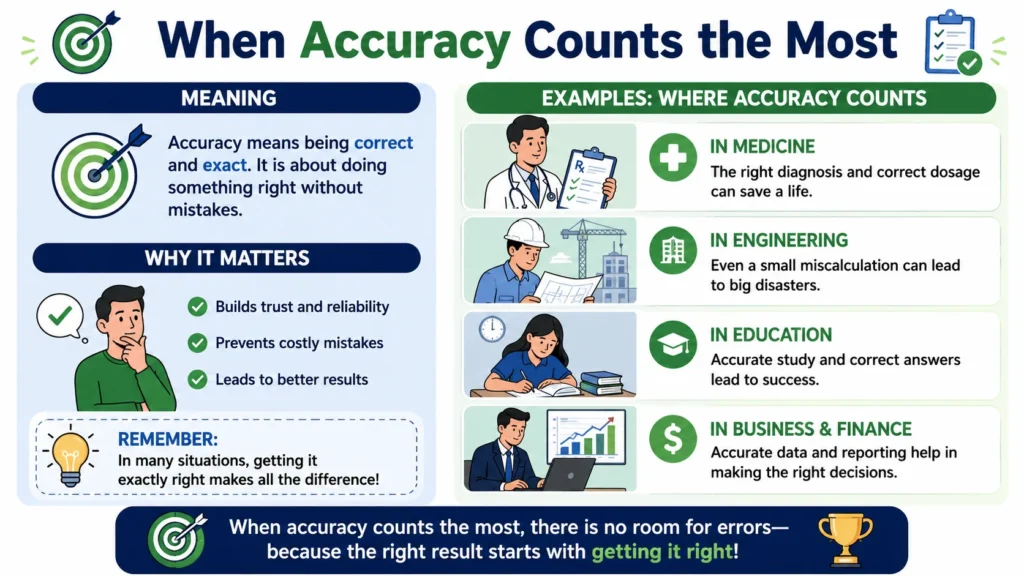
Accuracy signals intelligence, care, and attention to detail. A tiny spelling error might not seem like a big deal. Yet people often judge writing harshly especially in professional settings.
You’ll stand out—positively or negatively—depending on how consistently you avoid mistakes like happend.
Here’s where accuracy matters most.
When Accuracy Counts the Most
Professional Emails
Managers, clients, and coworkers rely on clarity.
Mistakes weaken your credibility especially if you send reports or updates.
Job Applications
Recruiters scan for writing quality.
Correct spelling creates trust while errors raise questions.
Academic Writing
Professors expect precision.
Using incorrect forms like “happend” makes your work look rushed.
Technical Writing
Industries like IT, engineering, law, and healthcare require exact language.
Public Communication
Website content, announcements, or newsletters must stay error-free so readers trust your message.
Accuracy isn’t just about correctness. It frames your professionalism.
Memory Tricks to Remember the Correct Spelling
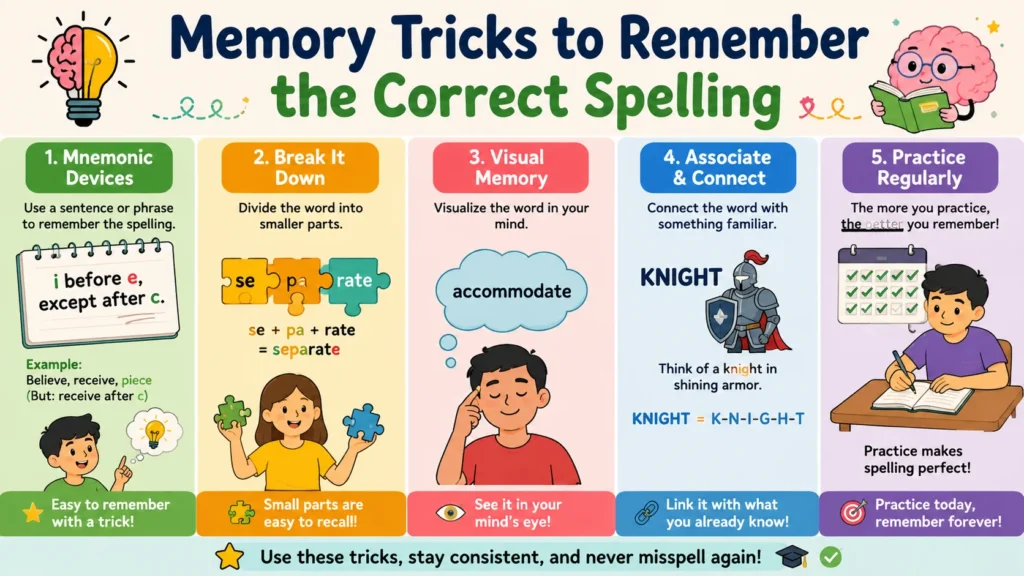
These quick tools help you remember the right form instantly.
Useful Memory Tricks
- Trick 1: The stress is at the start in “HAP-pen” so the “p” doesn’t double.
- Trick 2: Think of open → opened, listen → listened, happen → happened.
- Trick 3: The word contains the word “pen”—and that also has only one “p.”
- Trick 4: Imagine someone saying: “It happened once so it won’t happen again.”
- Trick 5: If it looks strange without the second “e,” that’s a sign the word is spelled correctly.
These tricks make the Happened vs Happend question disappear forever.
20 Real-World Examples of “Happened”
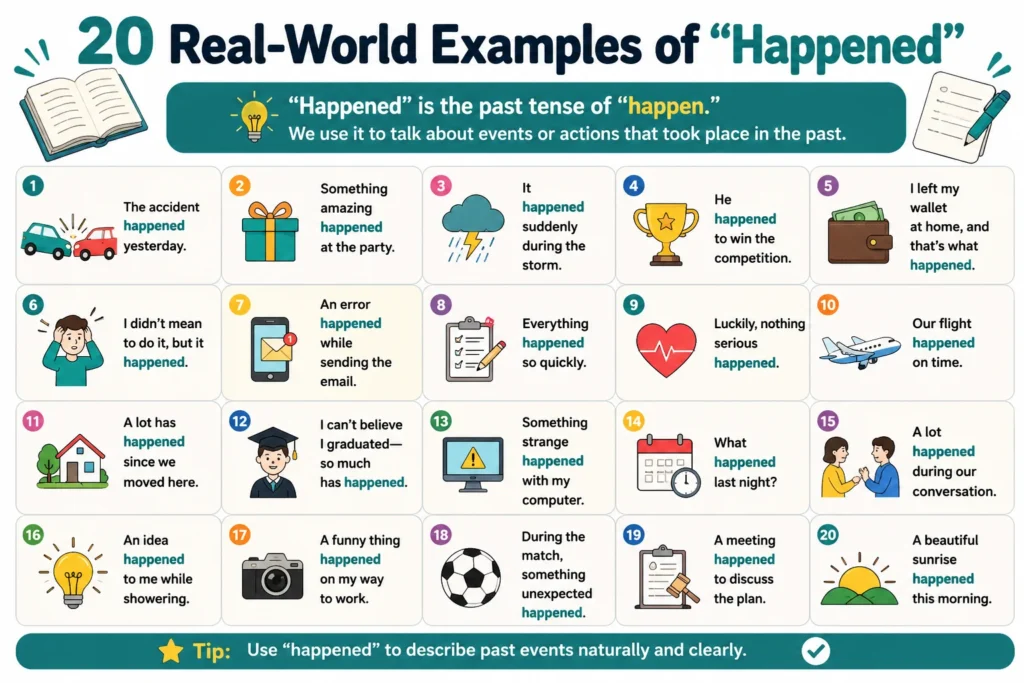
Below are sentence examples drawn from real everyday communication.
Casual Conversation
- “You won’t believe what happened after you left.”
- “Tell me what happened already.”
Messaging and Texting
- “Sorry I didn’t reply earlier, something happened.”
- “What happened at the meeting?”
Professional or Work Use
- “The delay happened due to incomplete paperwork.”
- “Something unexpected happened during the deployment.”
Academic or Formal Use
- “Significant changes happened once variables shifted.”
- “Nothing happened until the solution reached the threshold.”
Customer Support
- “We apologize this happened and we’re fixing it.”
Narrative Writing
- “Everything happened so rapidly.”
These examples reinforce that what happened works across every communication style.
Conclusion
Understanding the difference between happened and happend may seem small, but it plays a big role in clear and professional writing. The correct spelling, happened, follows standard past tense rules in English, while happend is simply a common mistake. By paying attention to spelling patterns, practicing regularly, and remembering the extra “e,” you can avoid confusion and write with confidence in both casual and formal situations.
FAQs
Q1. Is “happend” ever correct in English?
No, happend is always incorrect. The correct spelling is happened.
Q2. Why do people commonly write “happend”?
People often drop the extra “e” by mistake because they type quickly or misunderstand past tense spelling rules.
Q3. What is the rule behind “happened”?
Happened is the past tense of happen, and it follows the rule of adding “-ed” to the base verb, keeping the correct vowel structure.
Q4. How can I remember the correct spelling?
A simple trick is to remember that happen becomes happened by adding “-ed” without removing the “e.”
Q5. Does using “happend” affect writing quality?
Yes, using incorrect spelling can make your writing look unprofessional and may confuse readers.
