
Losing vs Loosing often confuses English learners because one extra letter changes the meaning, usage, and context completely in writing.When I first began reviewing written English, I noticed this mistake more often than I expected. Although the words look similar, they have different purposes in the English language. Losing is the verb form of lose and can mean to fail, experience defeat, become defeated, suffer failure, misplace an item, or no longer keep something because you are deprived of it. Loosing, however, comes from loose and means to release, let go, setting something free, or making it less tight. This distinction explains why the words differ, even though they appear almost identical. Looking at their definition, definitions, differences, sentence meaning, contexts, examples, patterns, synonyms, etymology, and careful comparison makes them much easier to understand and remember.
In everyday writing, I regularly see writers, writers, students, learners, learners, and many people make this common confusion in emails, essays, academic writing, articles, reports, professional publications, professional documents, documents, publication, reporting, message, text, and social media posts. A spelling mistake, spelling confusion, or simple typo can affect communication, writing clarity, clarity, and even professional credibility. Paying attention to grammar, grammar rules, being grammatically correct, improving writing skills, communication skills, language usage, following correct usage, avoiding incorrect usage, checking pronunciation, proofreading, editing, orthographic awareness, using observation, memory, tricks, steady practice, and better attention all help improve accuracy and confidence. They also help you recognise, understand, apply, retain, strengthen, and master the correct spelling while expanding your vocabulary, learning, and language learning.
Many seasoned professional editors have wondered which spelling to write after hitting the wrong keys. A quick check, short pausing, or an exact search can prevent slips, mistakes, mistakes, errors, misunderstandings, and mix-ups before they change an entire sentence. This complete guide helps ensure clear, accurate, confident, and precisely communicating in formal, casual, everyday, and real-life situations. Thousands of people make this query every month because one letter can lead to the wrong choice. The good news is that the answer is simple, even if the mistake is surprisingly common. Once you start remembering the rule, intend to use it correctly, carry it into new ways of communication, know what each word refers to, how it is used, and what it means, you will naturally spot the correct spelling whether you win or lose.
Losing vs Loosing – Understanding the Core Difference
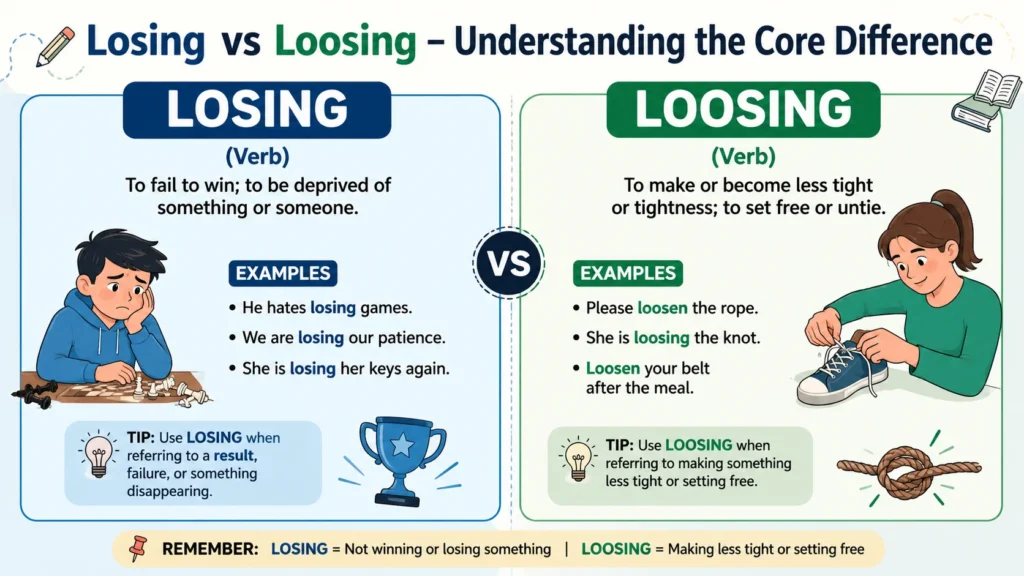
Confusion comes from how similar these words appear at first glance. You see losing, then losing, and your brain assumes they mean the same thing. They don’t.
What “Losing” Means
Losing is the present participle of the verb lose. It means:
- failing to win
- misplacing something
- being deprived of something
- becoming unable to maintain control
You use losing in everyday conversations. In fact, it appears in nearly every domain of life — from sports to emotions.
What “Loosing” Means
Loosing is the present participle of loose, a verb meaning:
- to release
- to set free
- to unfasten
- to relax tension
You rarely need this spelling unless you’re discussing rituals, tightening objects, religious texts, or technical mechanical actions.
Side-by-Side Comparison Table
| Word | Root Verb | Meaning | Example Sentence | Common in Daily Use | Pronunciation |
| Losing | Lose | failing to win, misplacing, or no longer having something | “They are losing the match.” | Yes | LOO-zing |
| Loosing | Loose | releasing, unfastening, or setting free | “The workers are losing the bolts.” | Rare | LOO-sing |
A Simple Memory Trick
Use this rule:
If the meaning involves misplacing, failing, or weakening control, the correct spelling is losing (one O).
If it involves making something less tight or releasing it, use loosing (two O’s).
Another trick:
Loose (with two O’s) rhymes with “moose.”
When you lose something, you “let it loose.”
But you never “let it lose.”
Understanding What “Losing” Actually Means
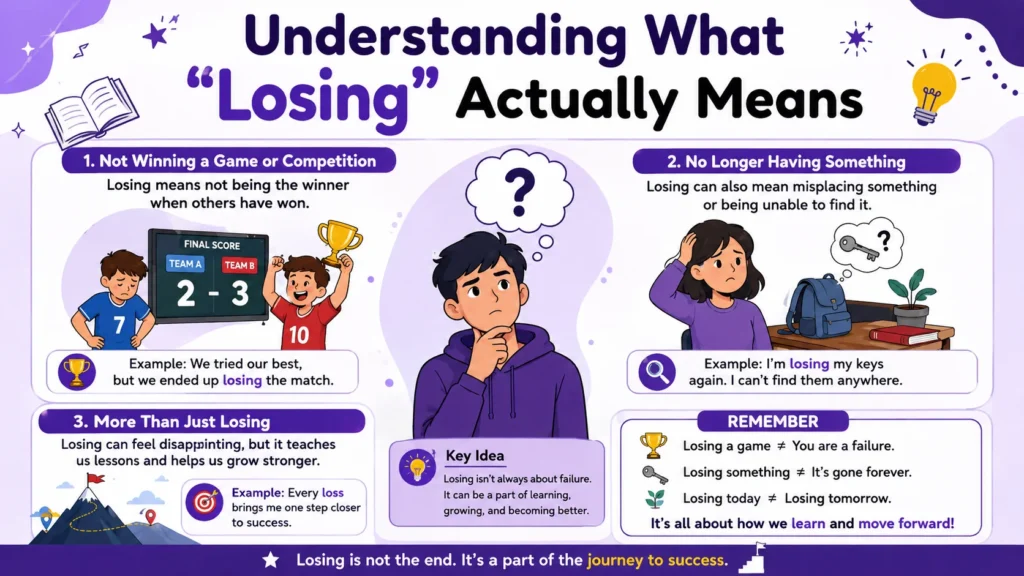
You encounter the word losing in so many contexts that it acts almost like a linguistic chameleon. The meaning shifts slightly depending on the situation, yet it always revolves around the core idea of no longer having something.
Common Uses of “Losing”
You’ll see losing used in four primary ways:
- Losing in a competition
“The team is losing the championship game.” - Losing an object
“You’re always losing your keys.” - Losing progress or an opportunity
“She is losing interest in the project.” - Losing control
“He’s losing patience.”
The word rarely sounds formal or exaggerated. Instead it communicates a straightforward loss, which is why it appears in regular speech all the time.
Real-Life Examples
A few examples demonstrate the versatility:
- “I’m losing my motivation to continue this task.”
- “They are losing money every quarter.”
- “The dog is losing hair because of the season change.”
- “You’re losing your voice from all that cheering.”
Every instance signals a kind of depletion or disadvantage.
Case Study: A Startup Losing Momentum
Imagine a tech startup that launches with energy. Customers sign up. Investors show interest. Growth looks explosive. Then the momentum slows because the team ignores feedback. Competitors innovate faster. The startup begins losing users, losing brand loyalty, losing market share, and finally losing investor trust.
That domino effect illustrates how one simple verb can describe multiple stages of decline.
Correct Grammar Usage of “Losing”
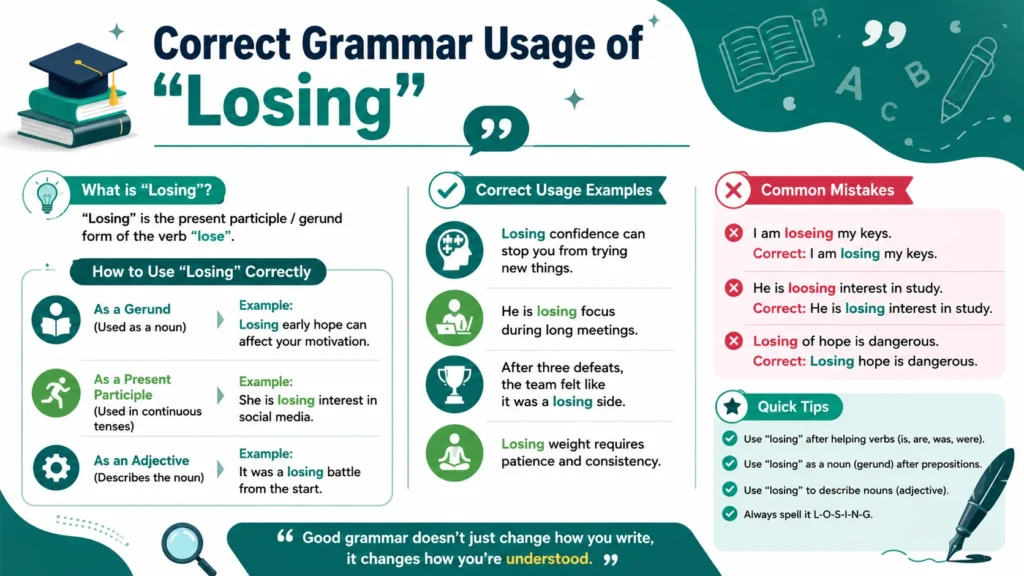
Since “losing” is a present participle, it can act as:
- a verb in progressive tenses
- a gerund
- part of an adjective phrase
Using “Losing” in Sentence Structures
Here’s how the word usually appears:
1. Present Progressive
“You are losing focus.”
2. Past Progressive
“They were losing the game before halftime.”
3. Future Progressive
“I will be losing sleep over this deadline.”
4. As a Gerund
“Losing weight requires consistency.”
5. In Descriptive Phrases
“The losing team stayed respectful.”
Correct vs Incorrect Examples
| Incorrect | Correct |
| “I am losing my wallet again.” | “I am losing my wallet again.” |
| “The company is losing money.” | “The company is losing money.” |
| “She feels like she’s losing control.” | “She feels like she’s losing control.” |
Even experienced writers make these errors. Knowing the root verb lose makes everything clearer.
Tense Forms of the Verb “Lose” (Connected to “Losing”)
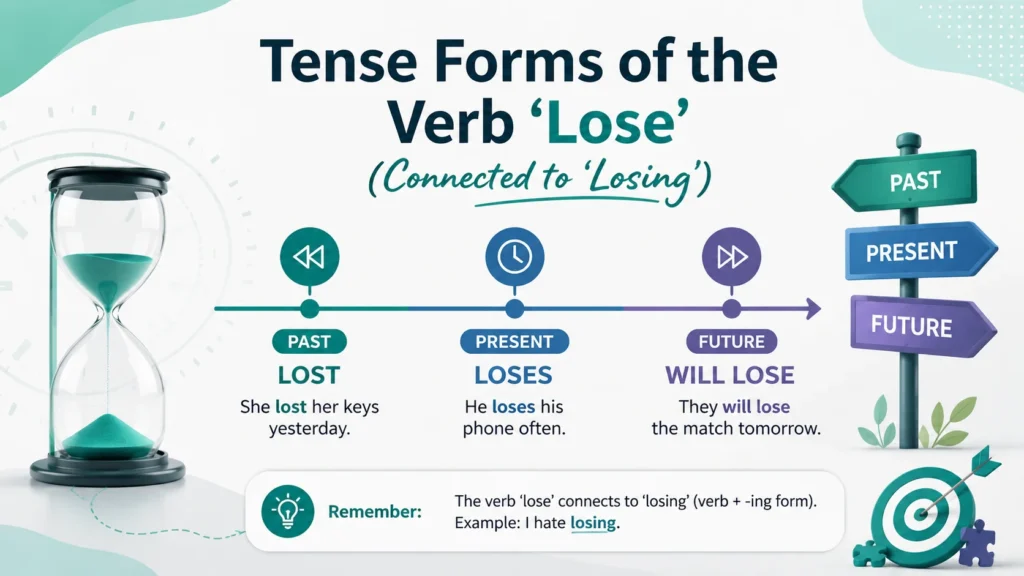
Understanding tenses helps you use losing in the right context.
Table of Tense Forms for “Lose”
| Tense Type | Form | Example |
| Simple Present | lose / loses | “They lose interest quickly.” |
| Present Progressive | am/is/are losing | “She is losing her voice.” |
| Present Perfect | have/has lost | “I have lost the receipt.” |
| Present Perfect Progressive | have/has been losing | “He has been losing weight fast.” |
| Simple Past | lost | “We lost the match.” |
| Past Progressive | was/were losing | “They were losing badly.” |
| Past Perfect | had lost | “The dog had lost its collar.” |
| Past Perfect Progressive | had been losing | “The company had been losing customers for years.” |
| Simple Future | will lose | “You will lose the chance.” |
| Future Progressive | will be losing | “I will be losing sleep tonight.” |
| Future Perfect | will have lost | “By then, we will have lost everything.” |
| Future Perfect Progressive | will have been losing | “They will have been losing money for a decade.” |
This structure illustrates where losing fits naturally.
Etymology of the Word “Losing”

Digging into a word’s history reveals why it looks the way it does.
Where “Lose” Comes From
The verb lose traces back to Old English losian, meaning:
- to perish
- to be destroyed
- to suffer a loss
Then Middle English transformed the word into losen and eventually loose. Through all these shifts the concept of loss stayed untouched.
How “Losing” Evolved
The ending –ing became common in English around the 14th century. Adding it to lose produced losing, which slowly replaced earlier variations like losing.
The modern spelling has remained stable for more than 400 years.
Comparison with “Loose”
Interestingly, loose comes from Old Norse lauss, which means:
- free
- unattached
- open
This divergence explains why lose (one O) and loose (two O’s) sound different and mean unrelated things.
What “Loosing” Means (And Why It’s Rare)
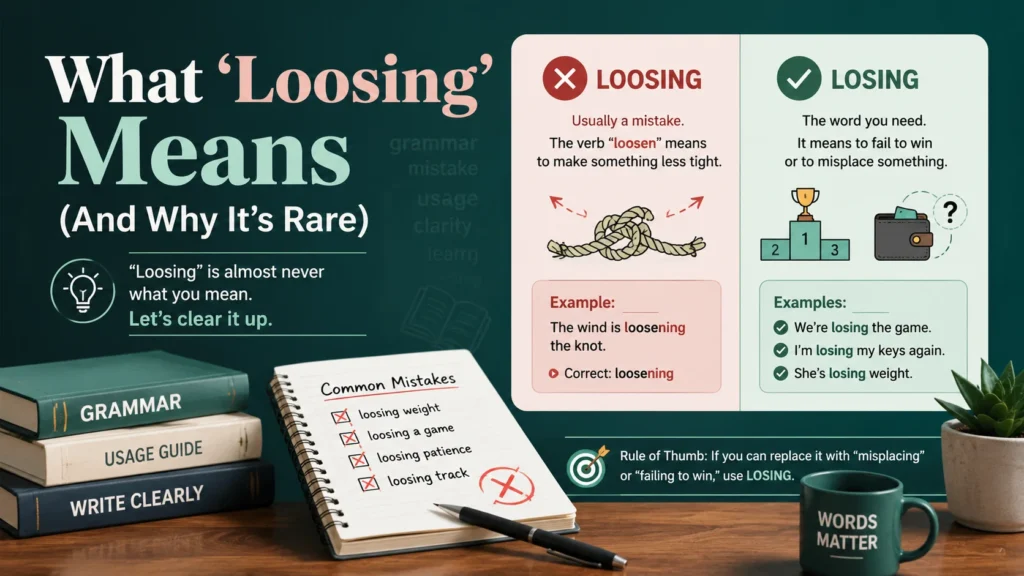
You rarely see “loosing” outside specialized fields because its meaning relates to freeing or unbinding something.
Legitimate Uses of “Loosing”
Here are situations where loosing is technically correct:
- Mechanical context
“The engineer is losing the bolts.” - Religious or ceremonial context
“The priest is loosing the restrictions placed on the congregation.” - Animal handling
“They are losing the horses from their harnesses.” - Metaphorical release
“She is losing her creativity after years of pressure.”
Still, modern English often uses “loosening” instead. So even though losing exists, it remains rare.
Why People Confuse It
Many confuse losing with losing because:
- it looks similar
- double O words feel natural to English speakers
- spellcheck sometimes misses contextual errors
But the meanings are miles apart.
Common Mistakes and How to Avoid Them
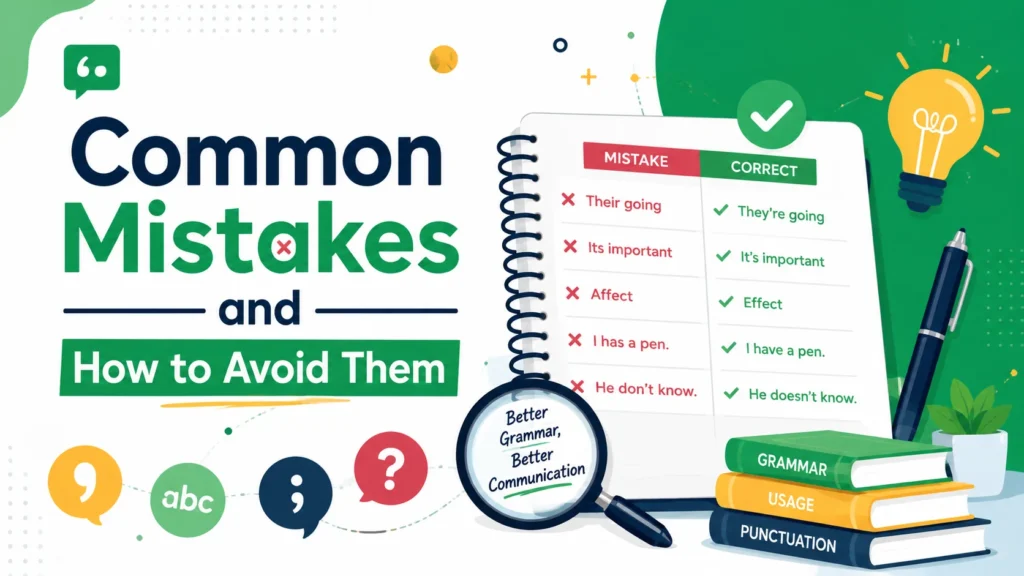
You can avoid most mistakes by remembering the root verb.
Mistake 1: Spelling “Losing” as “Loosing”
This mistake leads to misunderstandings.
Example:
“The business is losing clients.”
That sentence implies the company is releasing clients, which makes no sense.
Mistake 2: Thinking “Loosing” Is the Correct Form of “Loose”
The truth is that loosening is more common than loosing. When in doubt, default to “loosening.”
Mistake 3: Mispronouncing “Lose”
People sometimes pronounce it like “loose,” but the S in lose sounds like a Z.
Memory Hacks to Instantly Avoid Errors
- Hack #1:
Lose rhymes with “choose.”
So losing rhymes with “choosing.” - Hack #2:
Loose has more O’s because something loose has “extra space.” - Hack #3:
If the sentence means “to misplace,” use losing. - Hack #4:
If the sentence means “to release,” use loosing.
Practice Exercises (Test Your Understanding)
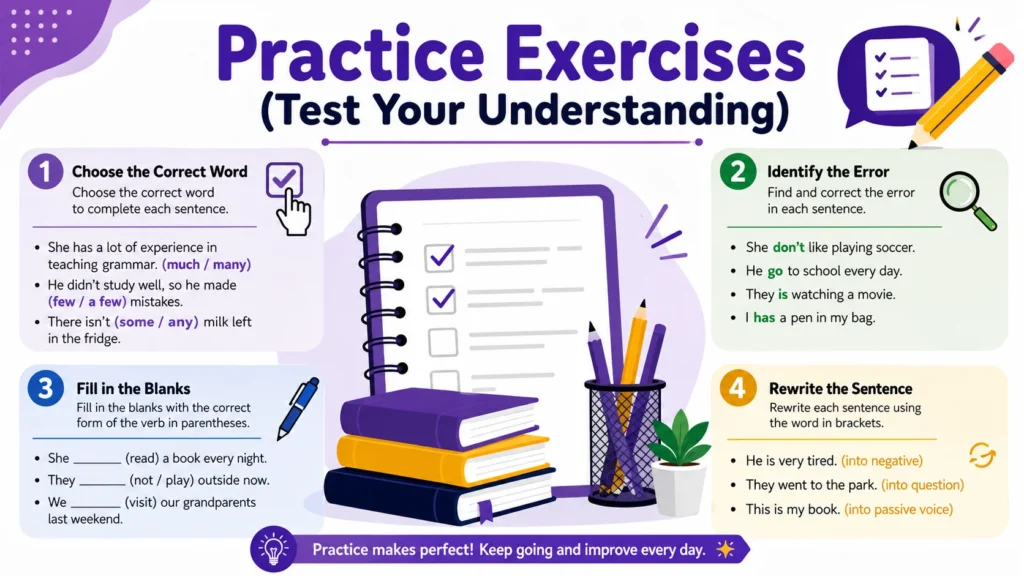
Try these exercises to strengthen your mastery of losing vs losing.
Fill in the Blank
- She is ______ her patience with the situation.
- The mechanic is ______ the tight screws.
- We are ______ the lead in the race.
- The captives are being ______ by the guards.
- I’m tired of ______ my phone.
- The coach warned that we are ______ to our advantage.
- Farmers are ______ water due to evaporation.
- The soldiers are ______ the restraints from the equipment.
Multiple Choice
1. Which sentence is correct?
A. “They are losing the game badly.”
B. “They are losing the game badly.”
2. Choose the correct form:
A. “I’m losing weight fast.”
B. “I’m losing weight fast.”
3. Pick the correct usage:
A. “The worker is losing the ropes.”
B. “The worker is losing the ropes.”
4. Which sentence makes sense?
A. “The community is losing parking rules next month.”
B. “The community is losing parking rules next month.”
Sentence Correction
Fix the errors:
- “I think I’m losing interest in this job.”
- “They were losing customers left and right.”
- “He is losing the belt because it is too loose.”
Answer Key
Fill in the Blank Answers
- losing
- loosing
- losing
- loosing
- losing
- losing
- losing
- loosing
Multiple Choice Answers
- B
- B
- A
- A (though “loosening” is more modern, “loosing” is still correct)
Sentence Correction Answers
- “I think I’m losing interest in this job.”
- “They were losing customers left and right.”
- Correct as written — this one tests comprehension.
Losing Synonyms (With Accurate Usage)
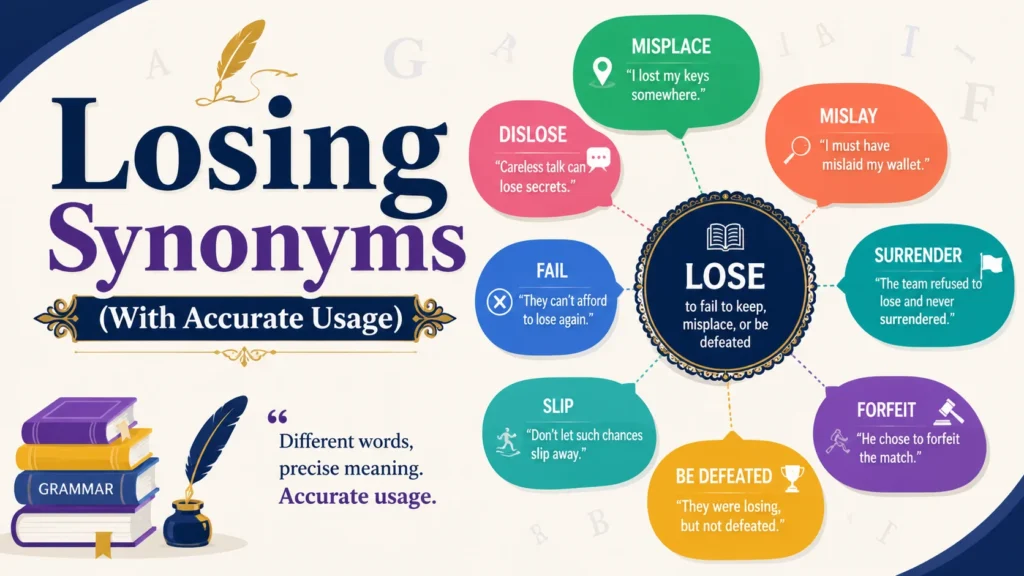
Different contexts demand different synonyms. The list below organizes them by meaning so you choose the right alternative every time.
When “Losing” Means Failing to Win
- falling short
- being defeated
- behind
- trailing
When “Losing” Means Misplacing Something
- misplacing
- overlooking
- dropping
- forgetting
- mislaying
When “Losing” Means Decreasing or Weakening
- diminishing
- waning
- fading
- declining
- slipping
When “Losing” Means Letting Go Emotionally
- releasing
- surrendering
- yielding
Synonym Table
| Context | “Losing” Synonym | Example |
| Sports | trailing | “The team is trailing by ten points.” |
| Objects | misplacing | “I keep misplacing my earbuds.” |
| Control | slipping | “My concentration is slipping.” |
| Emotions | surrendering | “She is surrendering her fears.” |
| Strength | diminishing | “His energy is diminishing.” |
Conclusion
Understanding Losing vs Loosing becomes much easier once you know how each word is used in everyday English. Losing is the correct choice when talking about failure, defeat, or misplacing something, while Loosing means releasing or making something less tight. Paying attention to spelling, context, and grammar helps you avoid common mistakes and write with greater clarity, accuracy, and confidence.
FAQs
Q1.What is the difference between Losing and Loosing?
Losing is the verb form of lose and means to fail, be defeated, or misplace something. Loosing means releasing, letting something go, or setting it free.
Q2.Is Loosing a real English word?
Yes. Loosing is a real word in English, but it is much less common than Losing. It usually means releasing, setting something free, or making it less tight.
Q3.Why do people confuse Losing and Loosing?
Many people confuse Losing and Loosing because the words have similar spelling, look almost identical, and sound alike in everyday communication. This often leads to a spelling mistake or typo.
Q4.How can I remember the correct spelling of Losing?
A useful memory trick is to remember that Losing comes from lose, which has one “o“. If you mean failure, defeat, or misplacing an item, then Losing is the correct spelling.
Q5.Can using Loosing instead of Losing change the meaning of a sentence?
Yes. Using Loosing instead of Losing changes the meaning of the sentence and may create confusion. Checking the context, grammar, and usage helps keep your writing clear, accurate, and professional.
