
When English learners, native speakers, and writers explore Nosy vs Nosey, the spelling choice can feel confusing because both versions appear in everyday communication. Many people stop, think twice, and question which form looks better before writing emails, blogs, social media posts, or professional documents. Both words describe someone who is overly curious about another person’s private matters, personal life, or business. The meaning stays the same, but the preferred form may change depending on the audience, context, and type of writing.
The main difference between Nosy and Nosey comes from spelling preference, not from meaning. Nosy is the more common and preferred spelling in modern American English, while Nosey remains an accepted variant spelling in some British English situations. Both forms are correct, identical, and equivalent in meaning. Many dictionaries, style guides, and grammar resources recognize both options, but professional writers often choose the standard spelling to maintain consistency, clarity, and better communication effectiveness. This spelling variation developed through changes in English orthography, regional patterns, and writing conventions over time.
From my experience with English vocabulary, grammar, and practical writing, I have seen many learners and students hesitate when choosing between these spellings. Understanding the correct usage, accepted spelling, and language rules helps writers feel more confident in different situations, including academic writing, business communication, and casual conversations. Words connected with curiosity, inquisitive behavior, prying questions, meddling, and being a busybody all share similar ideas. Using the preferred spelling consistently can improve writing confidence, professional credibility, readability, and the overall quality of online content, messages, and documents.
What “Nosy” Means (Definition, Tone, and Real Usage)
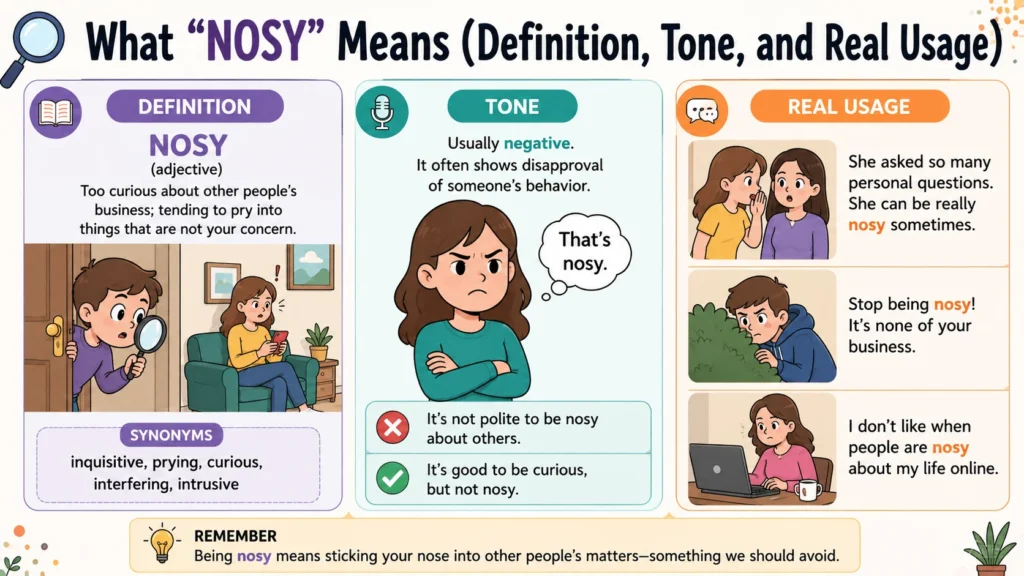
The word nosy describes someone who asks too many questions or pries into personal affairs. It’s informal yet widely accepted in everyday conversation, and it leans slightly negative. When you call someone nosy, you’re suggesting they crossed a boundary.
At the same time, the word doesn’t always sound harsh. Tone depends on the situation. For example, friends sometimes use it jokingly, while coworkers usually mean it more seriously.
Here’s the formal definition used by major dictionaries:
- Nosy (adjective): Showing too much curiosity about other people’s business; prying; intrusive.
Because of the “nose” connection, the word paints a vivid picture. You probably imagine a person sticking their nose into places it doesn’t belong. That imagery makes the term memorable and easy to use.
Where “Nosy” Appears in Real Life
Nosy shows up in casual conversations, workplace interactions and online posts. You’ll hear it used to describe the following:
- A coworker who asks personal salary questions
- A neighbor who comments on household routines
- A relative who pushes for relationship updates
- A social media friend who digs through old photos
- Someone who listens too closely to private conversations
These everyday scenarios help the meaning stick. The word’s popularity also stems from its simplicity. It’s short, easy to say, and it gets the point across without sounding extremely offensive.
Examples of “Nosy” in Sentences
Here are natural everyday uses:
- “You’re being a little nosy today.”
- “I like her, but she gets nosy when she’s bored.”
- “Don’t be nosy. It’s not your business.”
- “My neighbor is so nosy he knows everyone’s schedule.”
- “Stop being nosy and let me finish the story.”
These sentences show how flexible the word can be. Tone ranges from playful to critical depending on context.
What “Nosey” Means (Variant Spelling Explained)
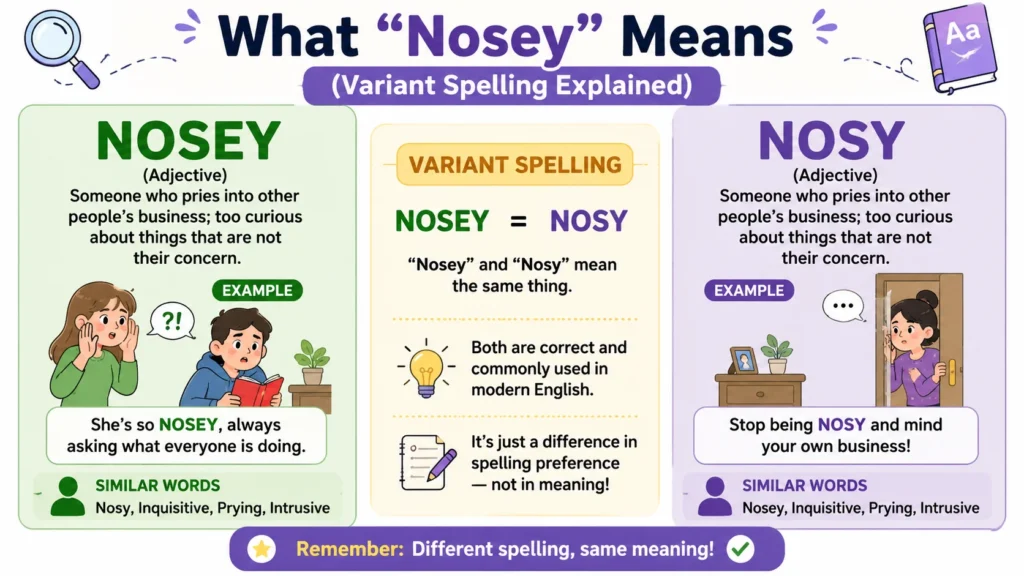
Now let’s talk about the second spelling in the nosy vs nosey debate. The word nosey is simply a less common variant of nosy. Both spellings mean the same thing, and they’ve both been used for more than a century.
Even though nosey isn’t technically wrong, it’s the less preferred version in modern American English. You’ll still see it in British writing, older novels and social media posts. Some people choose it because the “nose” root feels logical. Others use it because they’ve seen both forms and assume they’re interchangeable.
Where “Nosey” Shows Up
While nosy dominates in US publications, nosey appears more often in:
- Older British books and letters
- Informal internet writing
- Content where writers prefer phonetic spellings
- Messages where the writer thinks “nosey” looks more intuitive
Readers usually recognize both spellings without confusion because the meaning is identical.
Examples of “Nosey” in Sentences
Here are authentic examples:
- “Don’t get nosey about my weekend plans.”
- “She’s always been a bit nosey but harmless.”
- “That reporter is nosey on a new level.”
- “You’re too nosey for your own good.”
These show the same tone and meaning you’d expect from the standard spelling.
Nosy vs Nosey: Key Differences You Should Know
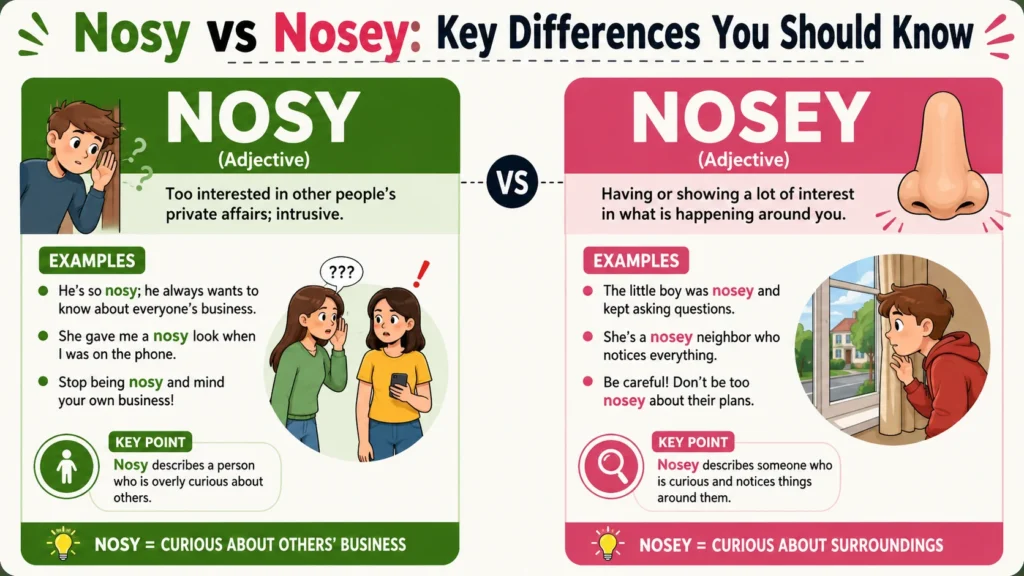
Even though the words carry identical meanings, a few key differences set them apart. Understanding these distinctions helps you choose the right spelling for your audience.
Meaning Comparison
There’s no difference in meaning. Both describe someone overly curious, intrusive or meddling.
Frequency of Use
Modern American English overwhelmingly favors nosy. It’s the spelling you’ll see in newspapers, online articles and professional communication.
Formality
Nosy is accepted in both casual and professional writing.
Nosey reads more informal and is rarely seen in business or academic settings.
Regional Preference
- United States: Nosy
- United Kingdom: Both versions appear, though nosy is still dominant
- Australia and New Zealand: Mostly nosy
- Canada: Mostly nosy
Tone Considerations
Some readers feel nosey comes off as slightly more playful because it closely resembles the word “nose”. Others feel it looks old-fashioned. Tone varies by audience, and that’s why choosing the standard spelling helps avoid misunderstandings.
Table: Quick Comparison of Nosy vs Nosey
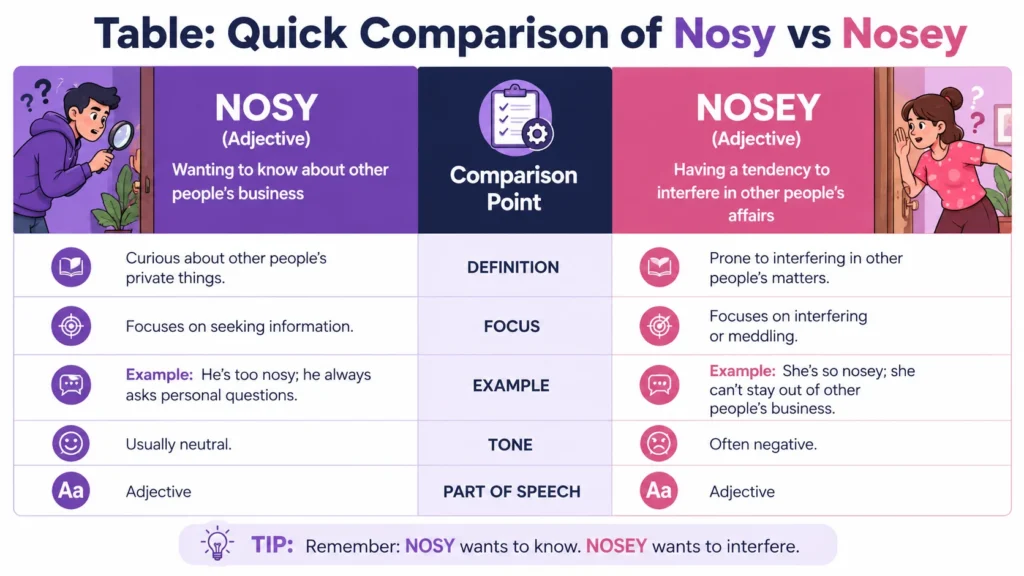
| Feature | Nosy | Nosey |
| Meaning | Overly curious, intrusive | Same meaning |
| Popularity | Most common worldwide | Less common |
| Professional Use | Widely accepted | Rare |
| Regions | US, UK, global | Mostly UK or older texts |
| Tone | Neutral-informal | Informal, sometimes playful |
| Dictionary Preference | ✔ Preferred | Listed as variant |
| Best Practice | Use in all writing | Use only if matching audience/style |
Which Spelling Should You Use? (Clear Recommendation)
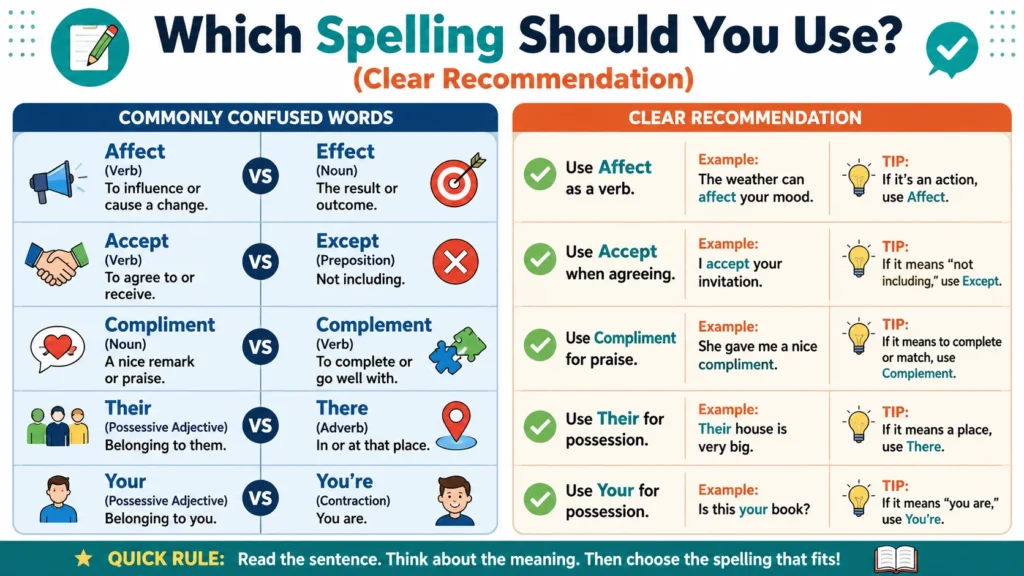
Short answer: Use “nosy” in almost every situation.
Here’s why.
Dictionaries like Merriam-Webster, Cambridge, Oxford Learner’s Dictionary and American Heritage list nosy as the primary spelling. Professional editors, journalists and educators also prefer it. You’ll appear more polished and reliable when you choose the standard form.
When “Nosey” Is Acceptable
You can use nosey when:
- You’re quoting someone who used that spelling
- You’re writing creative dialogue and want a specific character voice
- You’re matching regional dialects for storytelling
- You’re writing humor and want to emphasize the “nose” imagery
However, for business communication, resumes, cover letters and academic work, stick with nosy.
Recommended Usage for Different Contexts
| Context | Best Spelling | Why |
| Business emails | Nosy | Looks professional |
| Text messages | Either | Style choice |
| Social media | Either | Casual setting |
| Published articles | Nosy | Industry standard |
| Creative writing | Either | Depends on character voice |
| Academic writing | Nosy | Formal preference |
Consistency builds credibility, so choose one and use it throughout your writing.
Everyday Situations Where “Nosy” or “Nosey” Appears
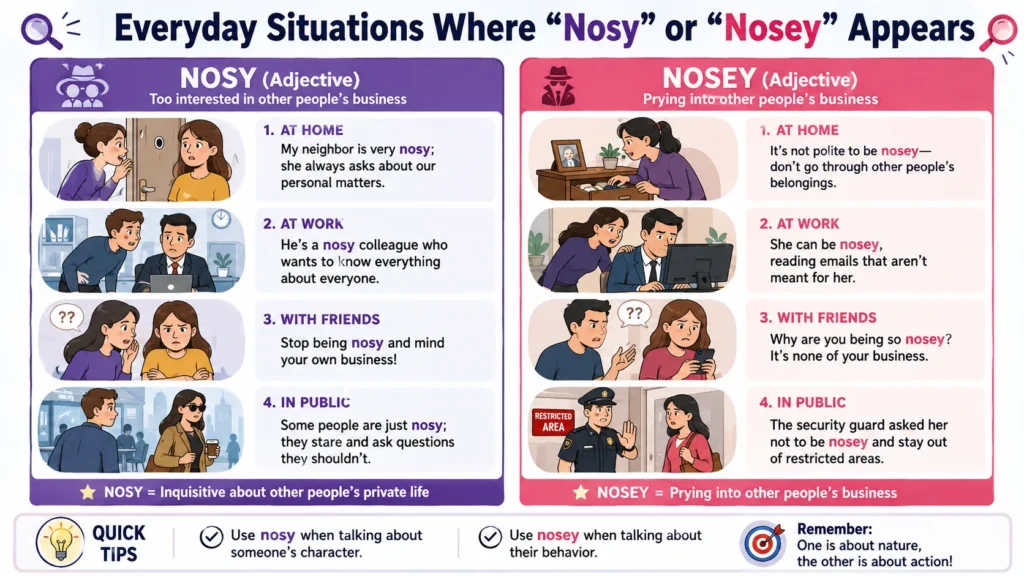
Both spellings appear in everyday communication. These examples help you see how tone shifts depending on the environment.
Conversation and Social Settings
People use the word when someone crosses a personal boundary. You might hear:
- “Don’t be nosy. I’ll tell you when I’m ready.”
- “You’re getting nosy about my dating life again.”
Workplace Examples
Work interactions require careful tone. Someone described as nosy at work might:
- Ask how much everyone makes
- Read over a coworker’s shoulder
- Spread private information
- Pry into meetings they’re not part of
Sample workplace use:
- “He’s great at his job but too nosy during team discussions.”
Family and Relationship Scenarios
Families often use the word playfully.
Examples:
- “Mom, stop being nosy.”
- “My sister is nosy in the funniest way.”
Social Media Use
People use it jokingly or critically:
- “My followers are nosy but I love it.”
- “Some of y’all get real nosy in the comments.”
Synonyms and Alternatives to Nosy (Tone-Adjusted List)
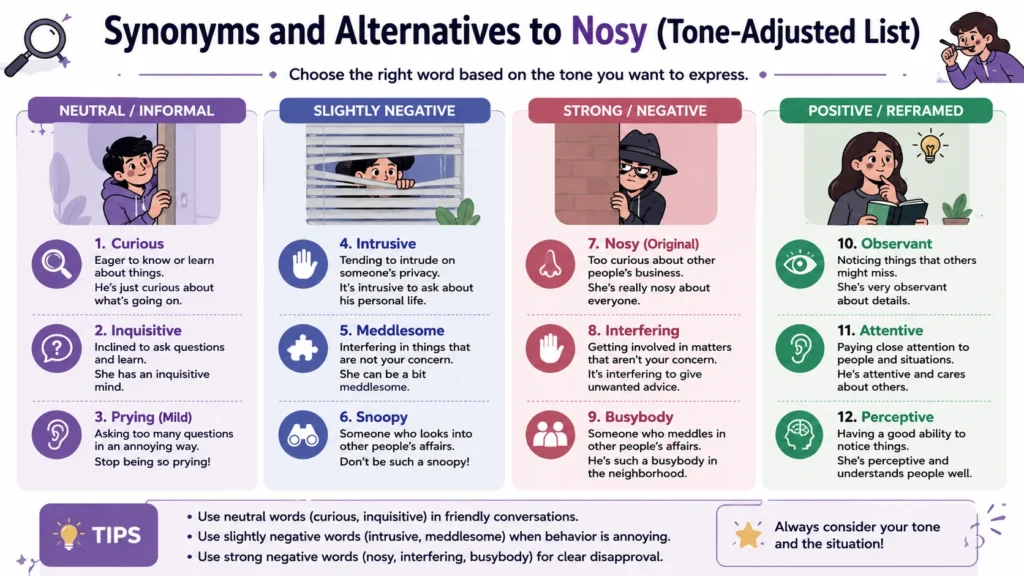
Sometimes nosy sounds too direct. Here are polished alternatives that soften or sharpen the tone depending on what you need.
Polite or Neutral Alternatives
- Curious
- Inquisitive
- Interested
- Observant
- Attentive
Mildly Negative Alternatives
- Prying
- Sneaky
- Overly curious
- Intrusive
- Meddlesome
Playful or Humorous Alternatives
- Sherlocking
- Snooping
- Being a detective
- Peeking
- Nosing around
Professional Alternatives
These work well in workplace communication where you want to maintain respect.
- “Overstepping boundaries”
- “Requesting information outside their role”
- “Asking for details not relevant to the task”
How to Respond When Someone Calls You Nosy (Friendly, Professional and Funny Replies)
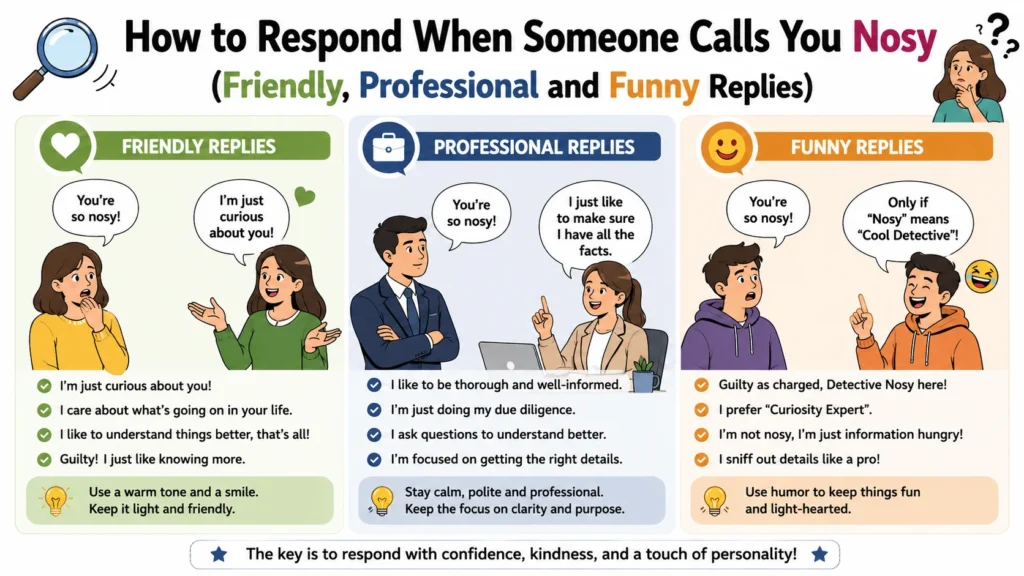
Getting called nosy can feel awkward. Your response depends on your relationship with the person and the context.
Friendly Responses
- “Maybe I just care too much.”
- “I’m curious, that’s all.”
- “Okay okay, I’ll stop digging.”
Funny Responses
- “I’m not nosy. I’m detail-oriented.”
- “I’m just collecting data.”
- “I ask questions because I like good stories.”
Professional Responses
- “I apologize. I didn’t mean to overstep.”
- “Thanks for pointing that out. I’ll respect your space.”
- “Let me know what details you prefer to keep private.”
These responses help maintain trust and ease tension.
Common Mistakes People Make With Nosy and Nosey
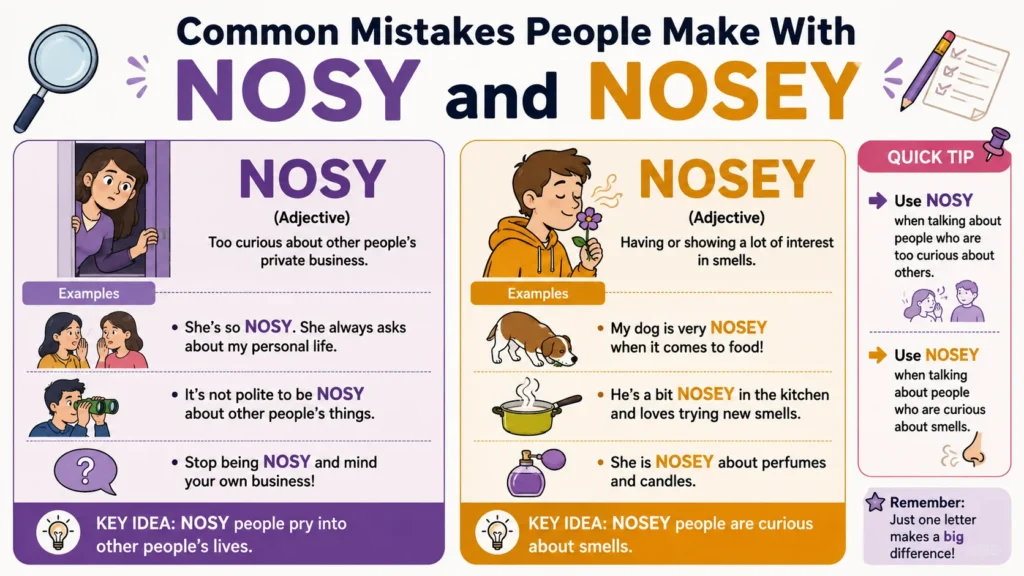
The confusion between the spellings leads writers to make predictable errors. Avoid these and your writing will feel polished and intentional.
Using “Nosey” in Professional Writing
This is the biggest mistake. Most editors consider nosey informal, so avoid it in serious communication.
Switching Spellings Mid-Document
Consistency matters for clarity. Choose one and stick to it.
Misjudging Tone
Calling someone nosy can sound harsher than intended. Always consider your audience before using the term.
Using It in Place of “Curious”
Nosy has a negative shade of meaning. If you mean “interested”, that’s the better choice.
Nosy vs Nosey Cheat Sheet
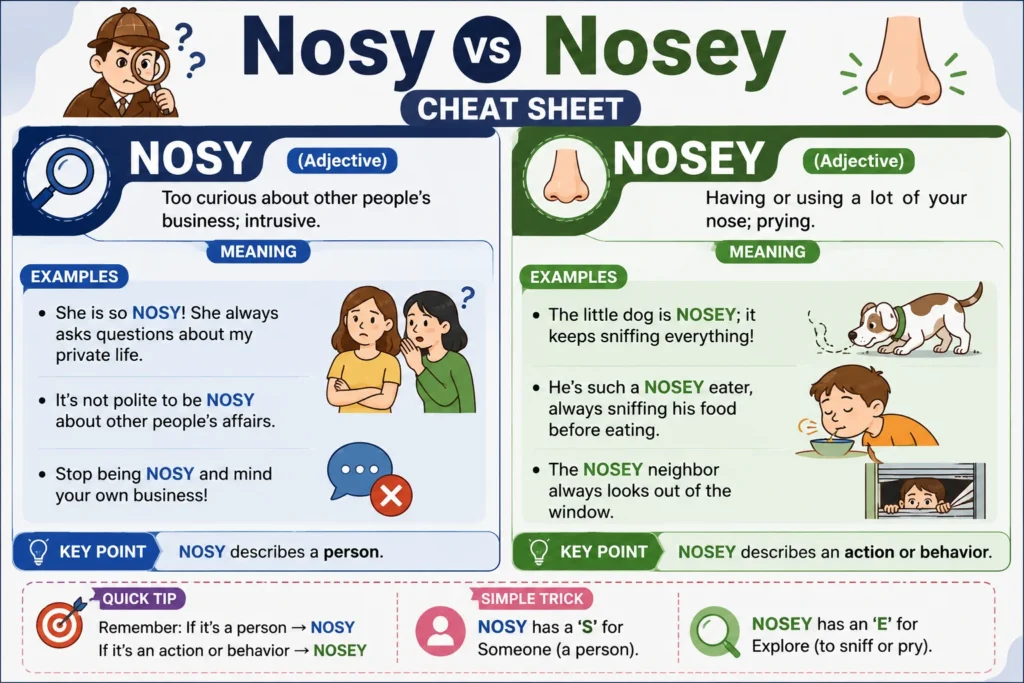
Here’s a simple guide you can save or screenshot.
- Correct spelling: Nosy
- Variant spelling: Nosey
- Meaning: Overly curious or intrusive
- Professional choice: Nosy
- Casual texting: Either works
- Best rule: When in doubt, choose nosy
This cheat sheet keeps things simple so you never hesitate again.
Conclusion
Understanding Nosy vs Nosey becomes much easier when you remember that both spellings have the same meaning. They describe someone who is overly curious about other people’s private matters or personal business. The main difference is based on spelling preference, regional usage, and writing style. Nosy is the more common choice in modern American English, while Nosey remains an accepted variant spelling in some British English contexts. Choosing the right form depends on your audience, purpose, and the type of writing you are creating. By learning these small spelling differences, you can improve your English accuracy, confidence, and communication skills.
FAQs
Q1. Is Nosy or Nosey the correct spelling?
Both Nosy and Nosey are correct spellings. They have the same meaning and describe someone who shows too much curiosity about other people’s affairs. However, Nosy is the more commonly preferred spelling, especially in American English.
Q2. What is the difference between Nosy and Nosey?
The difference between Nosy and Nosey is mainly a matter of spelling preference. There is no difference in meaning or usage. Both words are used as an adjective to describe someone who is too interested in other people’s personal matters.
Q3. Which spelling should I use in professional writing?
For professional writing, emails, academic work, and formal documents, Nosy is usually the safer choice because it is the standard spelling in modern American English. However, Nosey can still be appropriate depending on the audience and regional preference.
Q4. Why do people spell it as Nosey?
People use Nosey because it is an accepted alternative spelling that has appeared in English writing for many years. It is especially found in some British English contexts and informal usage.
Q5. Does Nosy mean rude or curious?
Nosy usually means someone is overly curious and asks questions about things that are private or not their concern. It can have a negative meaning because it often suggests unwanted interest, but the exact tone depends on the situation.
