
Usage or Useage causes confusion for many writers, yet one correct spelling builds confidence in professional writing quickly.I still remember the first time I paused while writing and asked myself if useage was a real word. Like many Non-native and native speakers, I felt uncertain and confused. Have you ever typed something and relied on a spell checker, but still got it wrong? You’re not alone—thousands of people search for usage every month because these words look similar. However, only one spelling is correct in standard English, and even a small mistake can affect school assignments, business emails, blog posts, and professional writing. From my experience, once you truly understand the pattern, your confidence improves and the confusion fades.
As a guide, I often tell writers, students, and professionals that the language can feel like a maze full of tricky intricacies. The key lies in understanding the origin, meaning, and implications of mistakes like misspellings. I’ve seen errors happen mid-email, in reports, and even on a screen while typing a single letter in a term meant for academic articles or quick texts. Without knowing proper grammar, punctuation, and rules, people may mistakenly use an accepted but incorrect form that can detract from professionalism. By observing common phrases, punctuation marks, and the manner they are used, your writing improves in clarity and overall quality. I suggest reviewing, exploring, and comparing differences across contexts, then providing guidance to unravel the puzzle, which saves time, reduces errors, and helps you opt for the right spellings and forms that ensure truth and effective communication.
Many learners think pronunciation explains everything, especially when an extra e seems like it belongs in a word, but English doesn’t always follow sound patterns. The good news is that it’s simple to fix this misspelling once you notice it. You’ll see it appear in both formal and informal settings, from everyday conversations to academic papers and business communication. I always remember how helpful it was to get feedback from readers and fellow learners; their suggestion made my writing more meaningful. If you hear advice from enthusiasts of the language, you begin to value these small connections. Stay happy, keep asking every question, and aim for clear expression—always. To Wrap things in spirit, Whether we’re beginners or experienced, we all have something to learn from our mistakes. Stick with basics, return to them a little At a time, and you’ll naturally find your way out of this confusion together.
Quick Summary
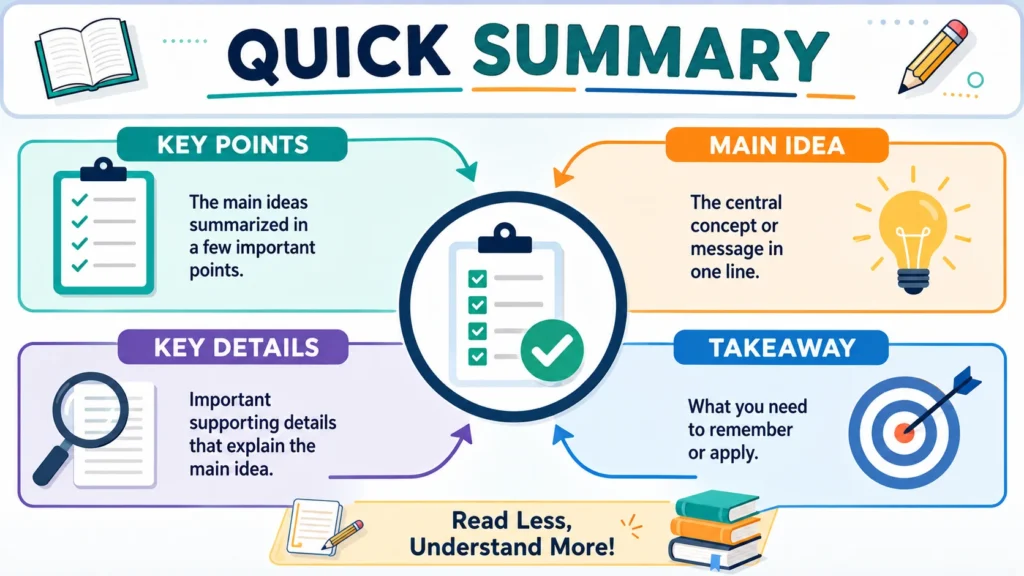
- Correct spelling: Usage
- Incorrect spelling: Useage
- Definition: The manner, amount, or way something is used; a practice or custom.
- Key point: “Useage” is not recognized in dictionaries and should be avoided in all formal and informal writing.
“Usage” vs “Useage”: The Core Difference
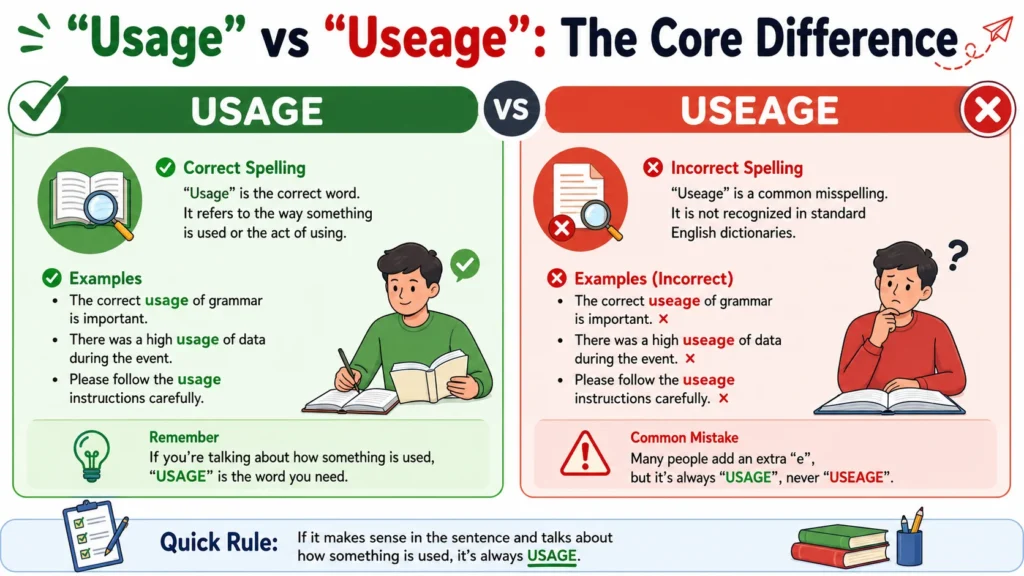
The difference is simple: “usage” is correct, and “useage” is always wrong.
Why do people add an “e”? It’s tempting because the verb is “use.” English often forms nouns by adding -age to a verb (like “marriage” from “marry”), but in this case, the correct noun form drops the extra e.
| Word | Correct? | Notes |
| Usage | ✅ | Standard English, dictionary recognized |
| Useage | ❌ | Nonstandard, incorrect spelling |
Where “Usage” Comes From (A Short History)
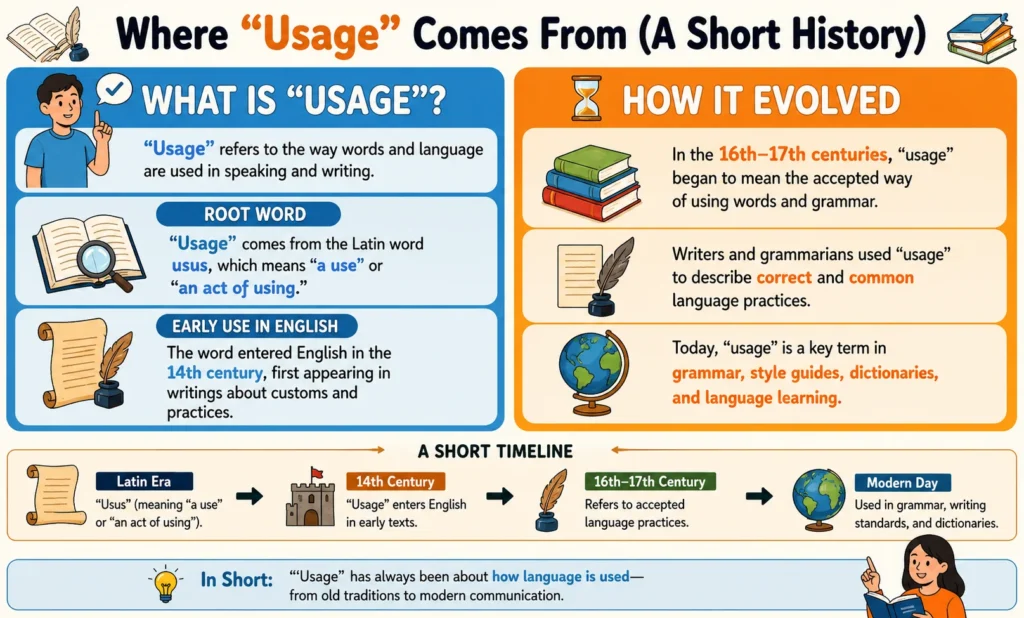
The word “usage” has been part of English since the Middle Ages. Its roots are in Old French “usage” meaning “custom, practice, or use.”
Over centuries, it evolved from referring to social customs to the modern meanings we use today: how something is used, language practices, and technical measures of consumption (like data usage).
Dictionaries like the Oxford English Dictionary trace “usage” back to the 14th century, confirming its legitimacy. In contrast, “useage” never appears in reputable historical sources.
Why “Useage” Appears Online (Even Though It’s Wrong)
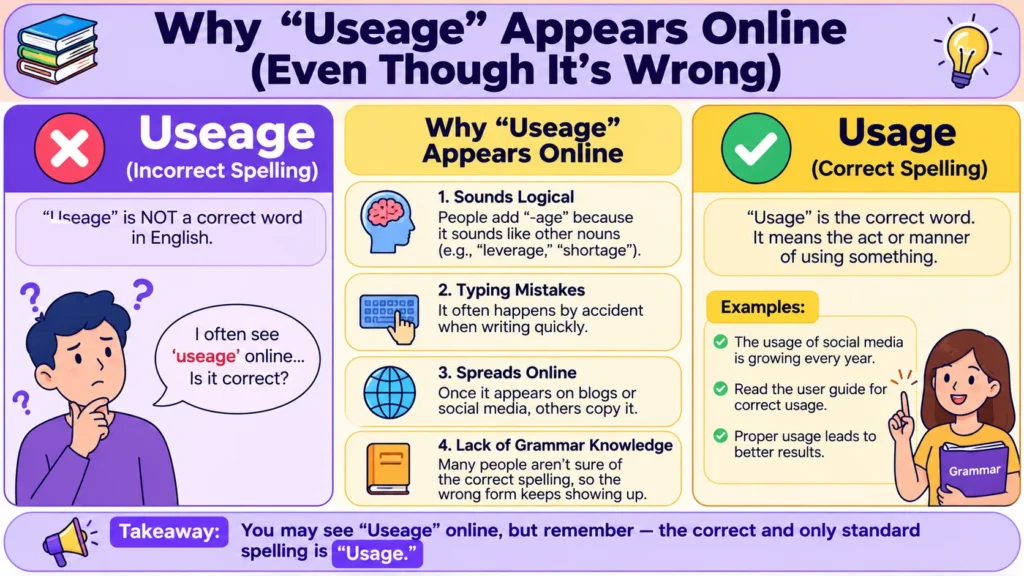
Despite its incorrectness, “useage” pops up frequently. Common reasons include:
- Memory mistakes: People assume “use” plus “-age” naturally becomes “useage.”
- Autocorrect errors: Some software may not flag “useage,” giving a false sense of correctness.
- Regional misunderstanding: Occasionally used in informal forums or blogs, but never in formal writing.
A quick Google search shows thousands of results for “useage,” but reputable dictionaries, style guides, and academic texts always favor “usage.”
Definition of “Usage”
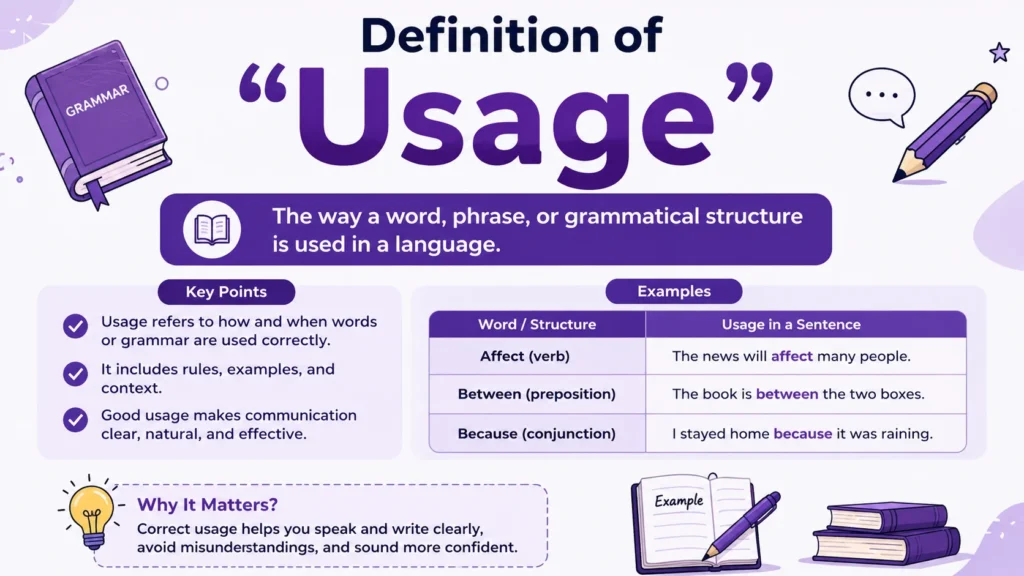
Usage can mean several things depending on context:
- General use or practice: The usage of smartphones has increased dramatically in the past decade.
- Custom or habit: Social etiquette dictates the proper usage of formal greetings.
- Linguistics: Incorrect word usage can confuse your readers.
Table: Dictionary Definitions of “Usage”
| Dictionary | Definition |
| Oxford English | The way in which a word or phrase is normally and correctly used |
| Merriam-Webster | Customary way of doing something; habitual practice |
| Cambridge English | The way that something is used; the act of using something |
Common Meanings & Uses of “Usage”
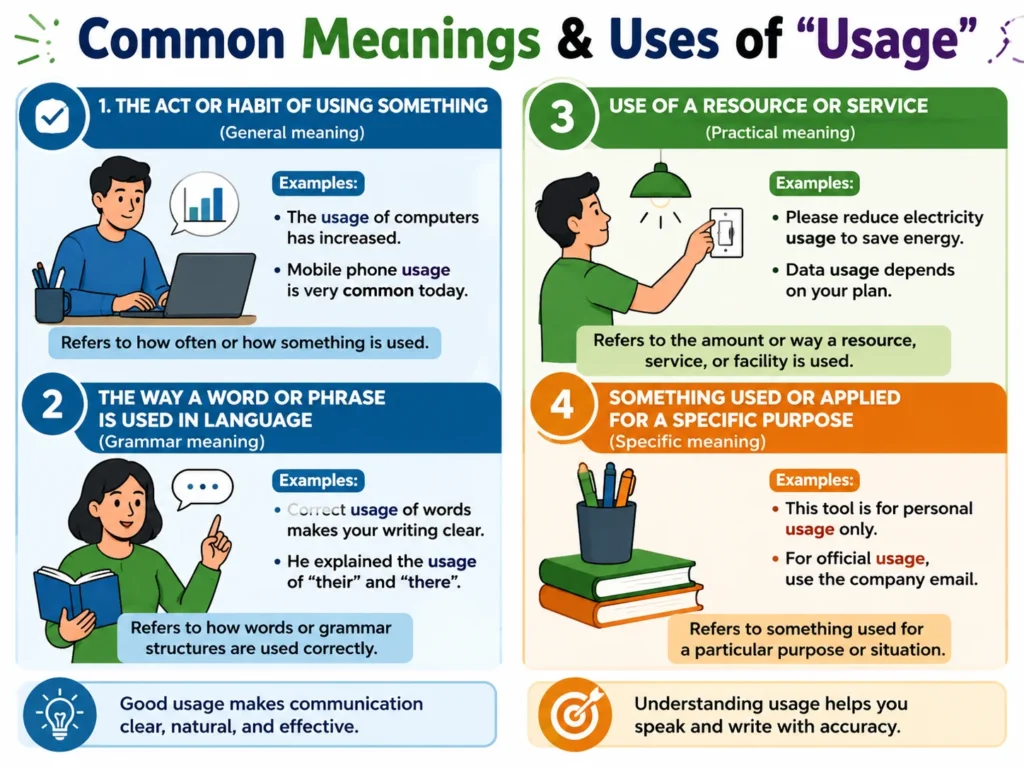
“Usage” appears across multiple fields. Here’s how:
- Business: Usage patterns reveal customer preferences.
- Technology: Monitor your internet data usage to avoid extra charges.
- Linguistics: Grammar books explain proper usage of words in sentences.
- Everyday life: The usage of kitchen appliances varies from household to household.
By understanding these different applications, you’ll use the word naturally in any context.
Why “Useage” Has No Valid Definition
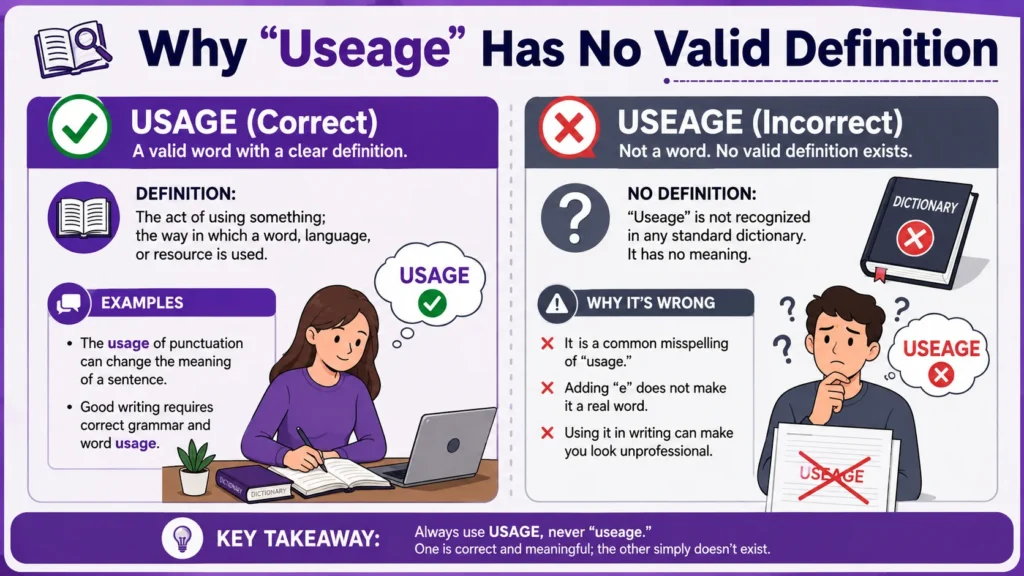
- No dictionary entry: Every major dictionary lists only “usage.”
- Not historical: No historical sources justify its existence.
- Incorrect in all contexts: From formal writing to casual emails, “useage” is always a mistake.
Word Forms Related to “Usage”
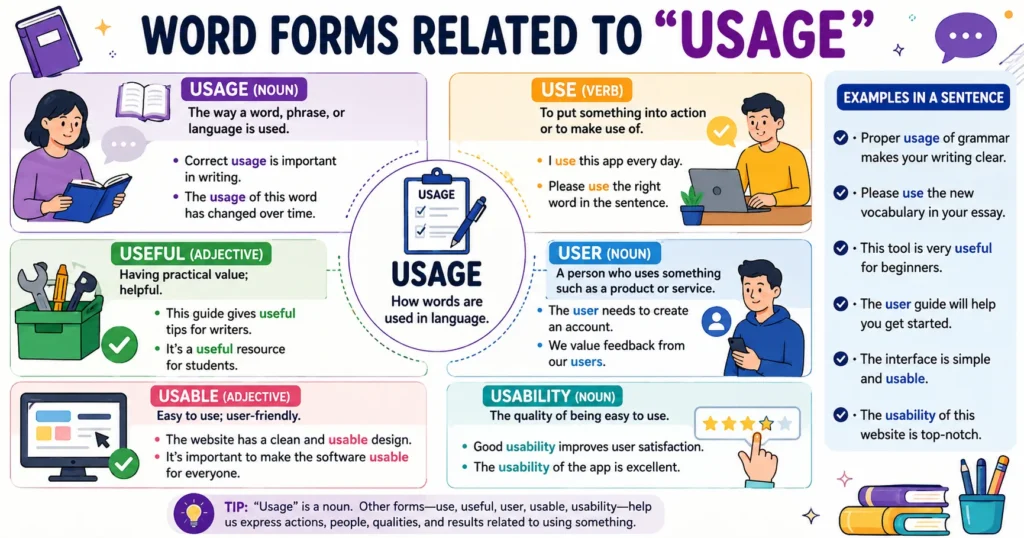
- Use (verb): I use my laptop daily.
- User (noun): The app has millions of active users.
- Using (gerund/participle): Using the right tool makes a task easier.
- Usable (adjective): This software is highly usable.
Understanding related forms helps reinforce that “usage” is the correct noun, aligning with English word formation rules.
Usage as a Noun
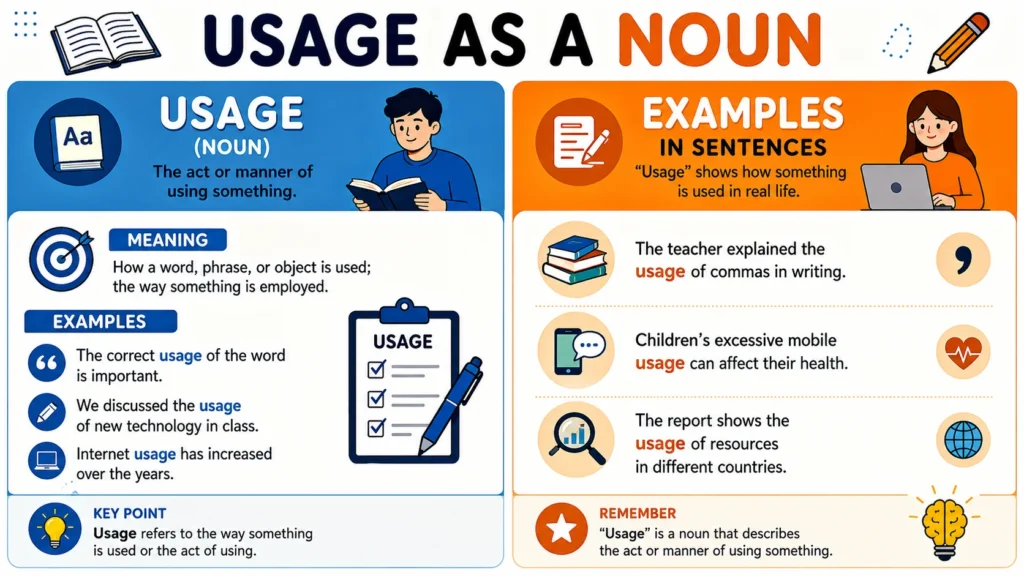
Usage is a noun and can be:
- Uncountable: Language usage evolves over time.
- Countable: Different usages of the word exist in English literature.
Example Sentences:
- Correct: The usage of mobile apps is increasing.
- Incorrect: The useage of mobile apps is increasing.
Side-by-Side Comparison Chart
| Feature | Usage | Useage |
| Spelling | Correct | Incorrect |
| Meaning | Standard English | None |
| Dictionaries | Recognized | Not recognized |
| Historical origin | Middle English | None |
| Example sentence | Proper usage is key in professional writing. | ❌ Improper usage. |
Everyday Example Sentences
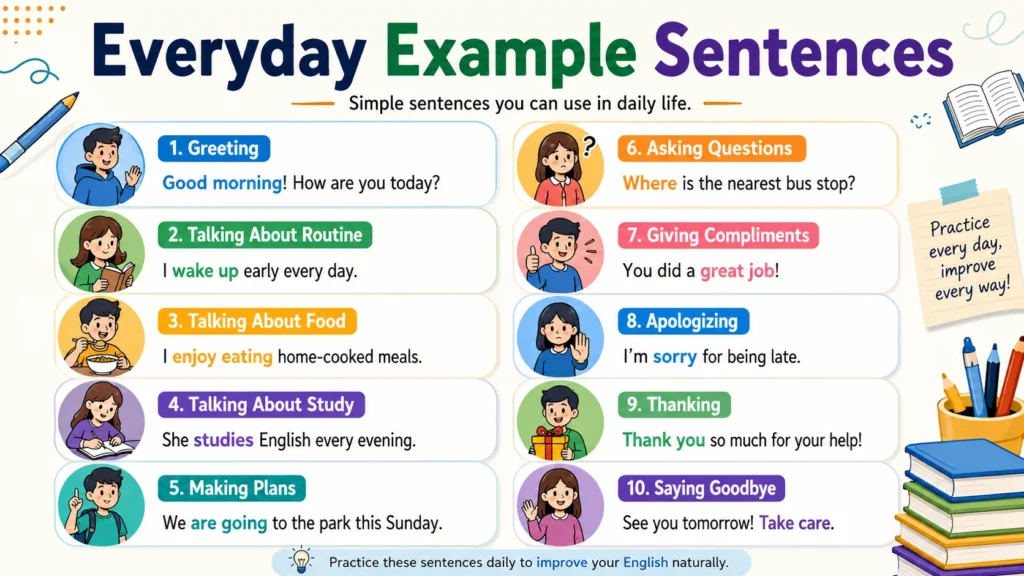
- The usage of public transportation has decreased during the pandemic.
- He explained the usage of the new software step by step.
- Proper grammar usage is essential in professional emails.
Notice how “useage” would break the flow and appear unprofessional.
“Usage” in Different Fields
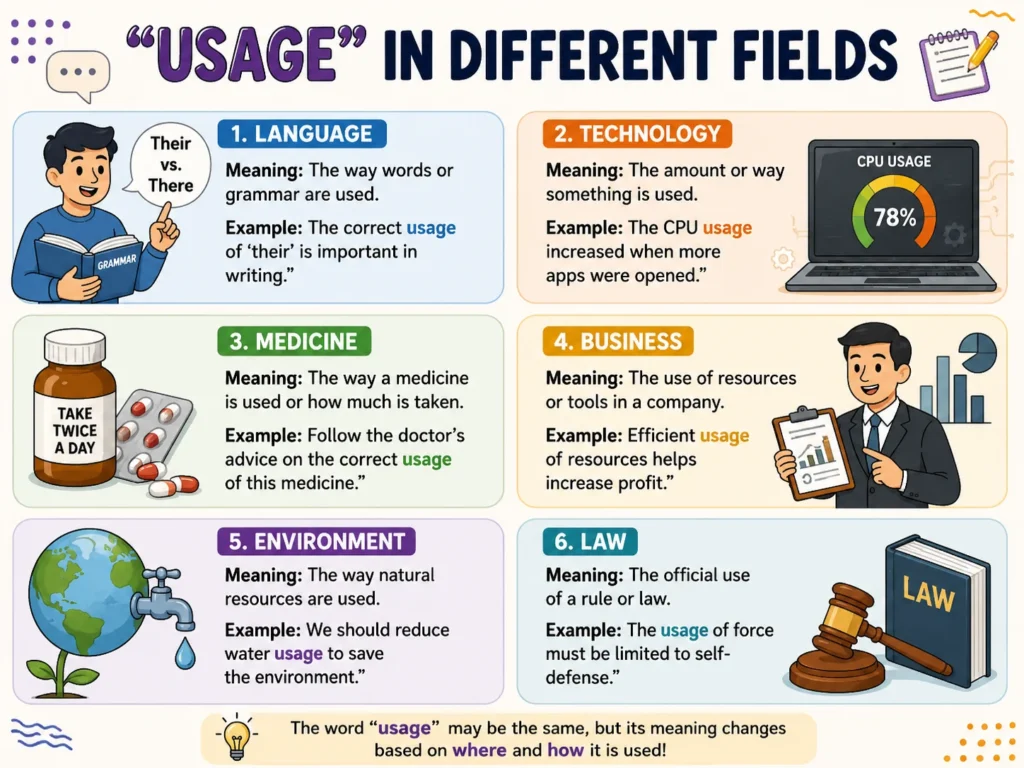
- Marketing: Understanding consumer usage patterns improves product design.
- Customer Service: Call centers track data usage to manage demand.
- Law: Legal documents often discuss the usage of specific terms or practices.
- Finance: Monitor credit card usage to maintain healthy spending.
- Linguistics: Dictionary editors analyze word usage to guide proper language instruction.
Usage in Literature and Public Speech
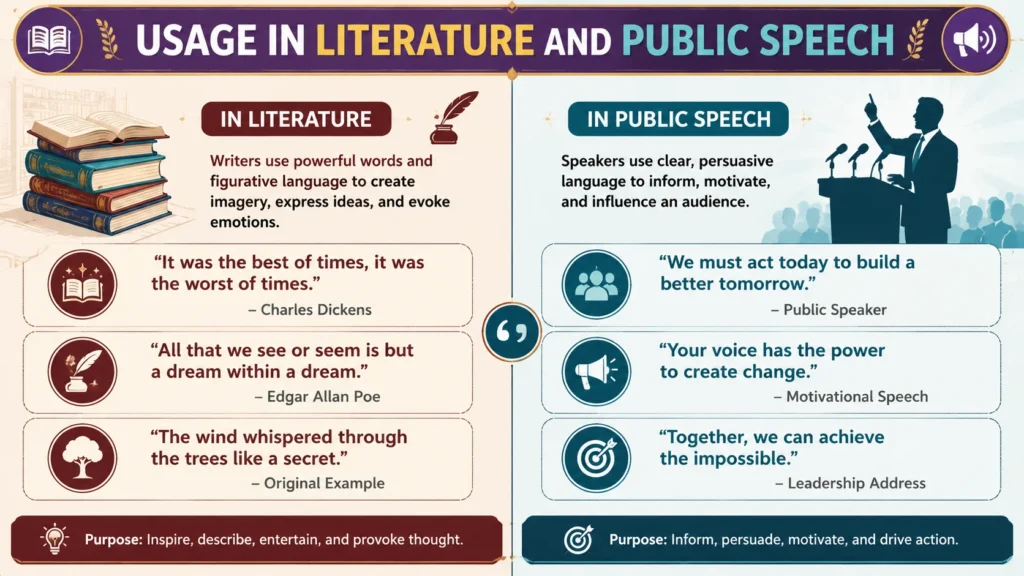
Authors and speakers rely on usage to convey meaning accurately.
- In literature: “Shakespeare’s usage of certain words reflects 16th-century norms.”
- In speech: Politicians focus on correct language usage to appeal to audiences.
Correct usage enhances clarity, while mistakes distract readers and listeners.
Common Expressions and Phrases With “Usage”
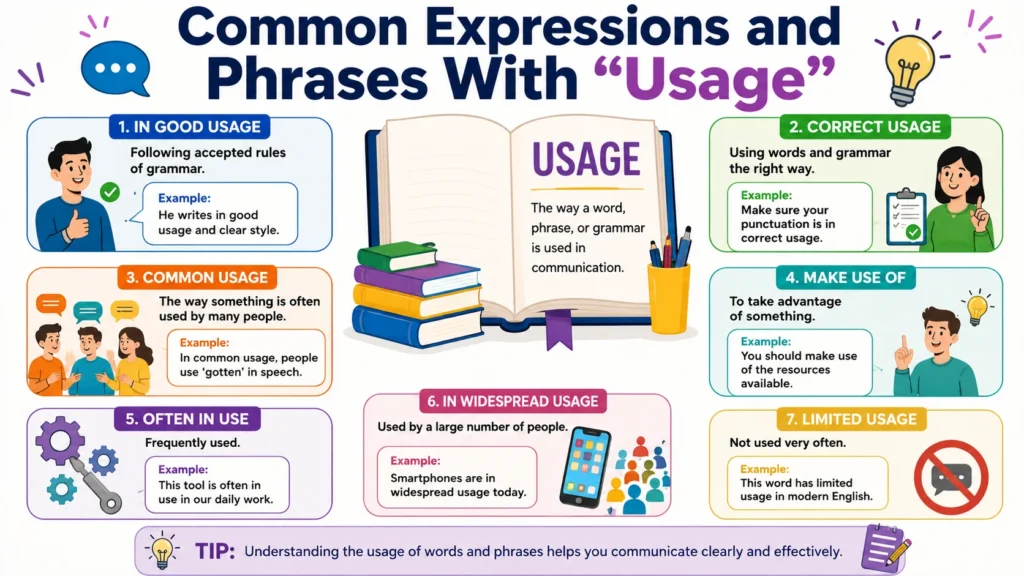
- Language usage – How words are used in writing or speech.
- Usage guidelines – Rules for using products or services.
- Data usage – Measurement of digital consumption.
- Common usage – The most widespread practice or understanding.
These phrases show the flexibility of usage across contexts.
The Correct Form: Why Only “Usage” Works
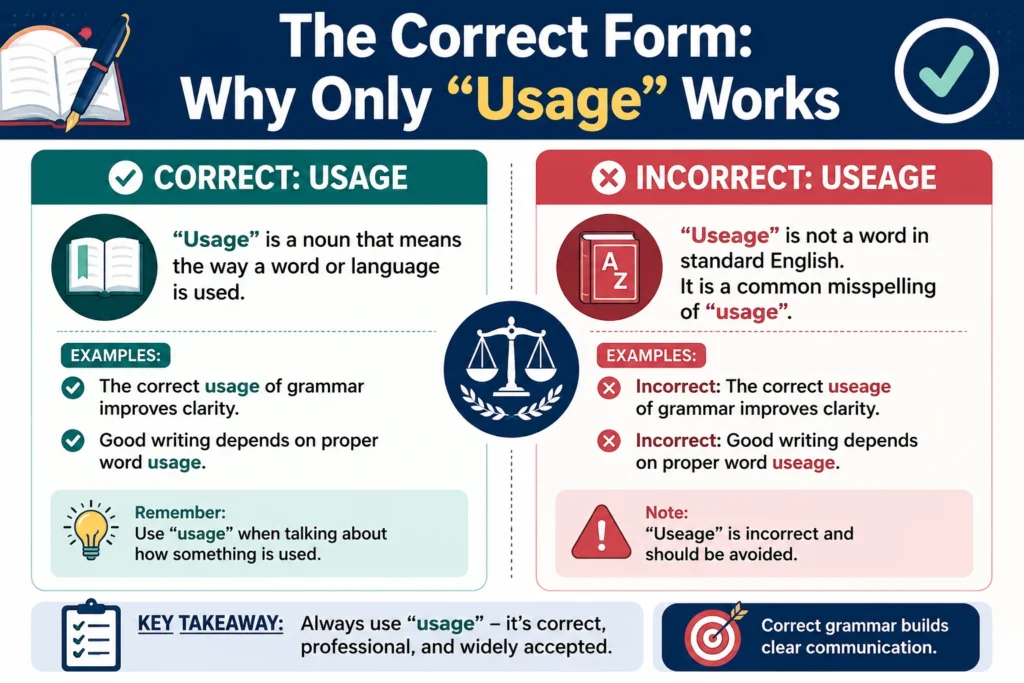
- English spelling rules: Drop the extra “e” when adding “-age” to the verb “use.”
- Dictionary alignment: Oxford, Cambridge, Merriam-Webster all list “usage.”
- Style guides: APA, Chicago, and MLA recommend usage exclusively.
Remember: Using the correct form signals professionalism and linguistic accuracy.
Common Spelling Mistakes and How to Avoid Them
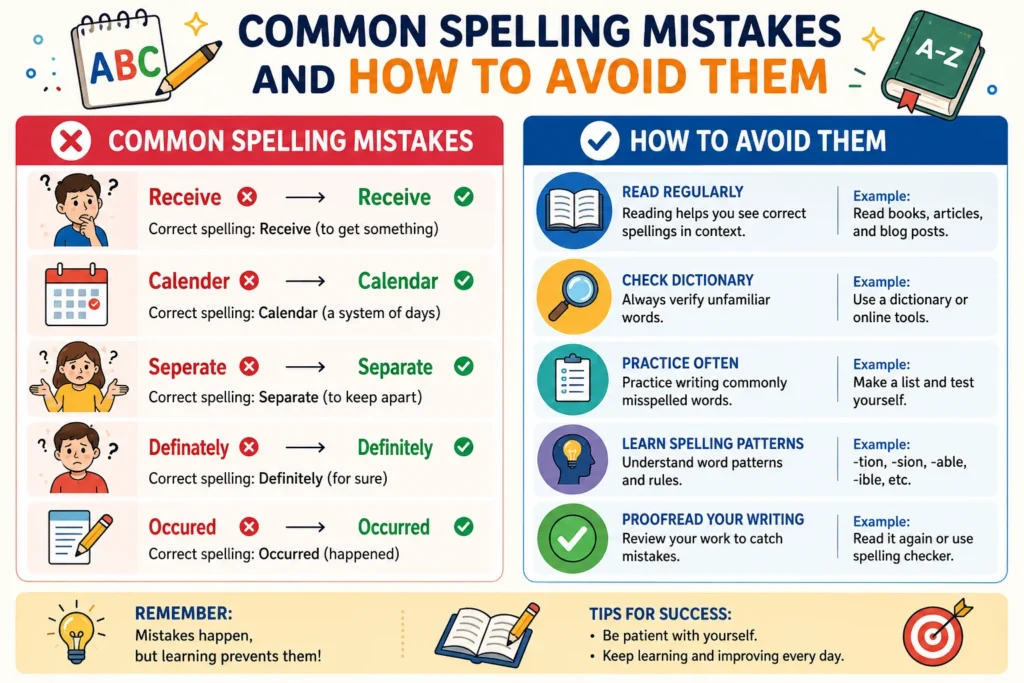
Frequent mistakes:
- Adding an unnecessary e: useage
- Confusing with similar words: dosage, passage, marriage
Tips to avoid mistakes:
- Memorize “usage” as the only correct form.
- Use spell-checkers wisely, but double-check when writing formal documents.
- Associate the word with its meaning: “usage is about how we use something.”
Misconceptions About “Useage”
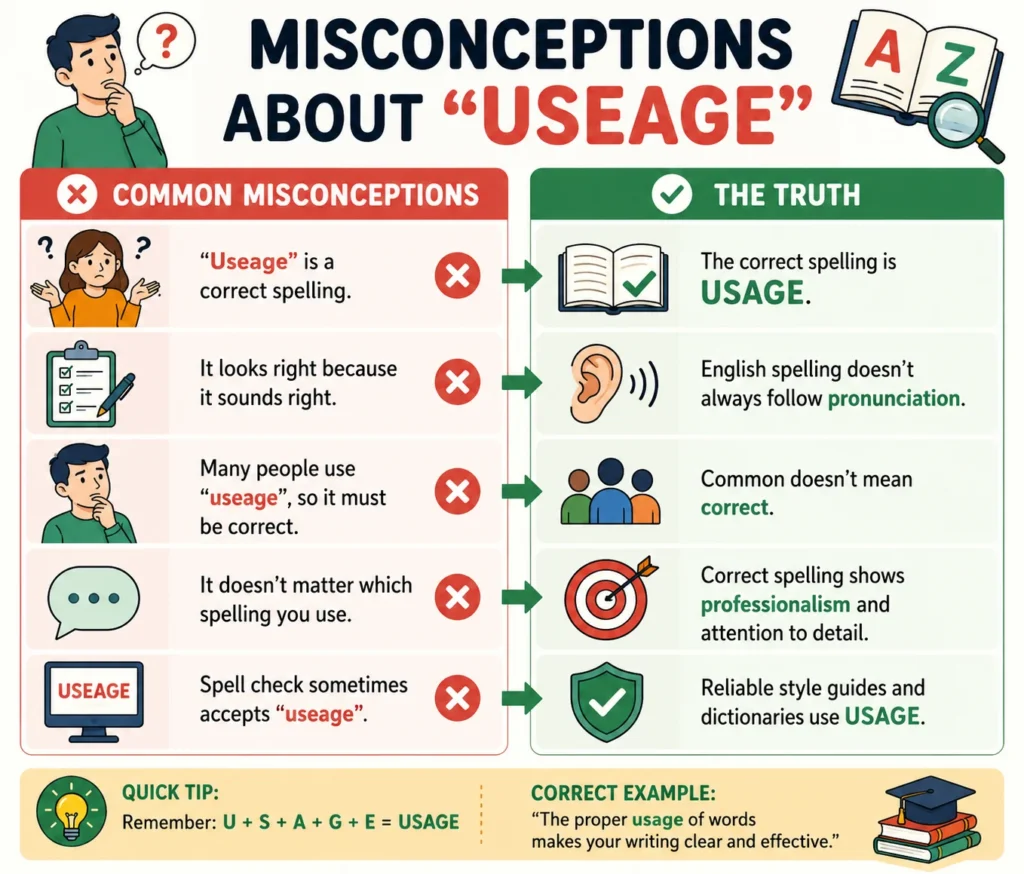
Some people mistakenly believe:
- It’s British English: It is not.
- It’s old-fashioned or archaic: No historical sources support this.
- Autocorrect allows it: Modern software can miss errors in casual typing.
Always rely on reputable dictionaries for guidance.
Tips to Master Correct Spelling
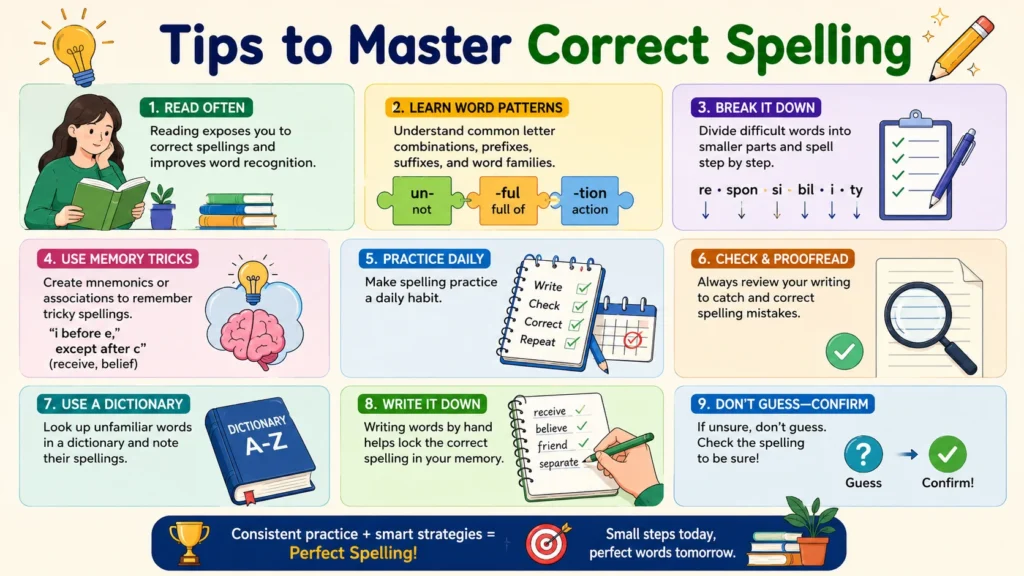
- Mnemonics: Remember “usage” uses the root without the extra e.
- Proofreading: Read sentences aloud to catch errors.
- Tools: Use Grammarly, Microsoft Editor, or dictionary apps.
- Practice: Write sample sentences using usage in different contexts.
Conclusion
Understanding Usage or Useage is simpler than it first seems. Once you notice that usage is the only correct spelling in standard English, the confusion quickly disappears. Many learners make this mistake because of how words sound, but English spelling doesn’t always follow pronunciation. From school work to professional writing, using the correct form helps you communicate clearly and confidently. The key is to stay aware, practice often, and learn from small errors. Over time, what once felt confusing becomes natural.
FAQs
Q1. Is “useage” ever correct in English?
No, useage is always incorrect. The correct spelling is usage in all forms of writing.
Q2. Why do people confuse usage with useage?
People get confused because of pronunciation. The extra “e” feels like it should be there, but it isn’t.
Q3. Where should I use the word “usage”?
You can use usage in academic writing, business communication, emails, blogs, and everyday English.
Q4. Will using “useage” affect my writing?
Yes, it can make your writing look less professional and may reduce clarity and credibility.
Q5. What is the easiest way to remember the correct spelling?
Remember that usage has no extra “e.” Keeping this simple rule in mind helps you avoid this common mistake.
